1 The game and its promises
Ayutthaya, 1563–1569. Kirin, the seventeen-year-old son of a neglected veteran, enters royal service with a gift for swordplay and a distaste for hurting people. War gives him the authority to protect a household, then a company, then a part of the capital. Each promotion also gives him people he can be ordered to sacrifice. Ayutthaya's first fall cannot be prevented. The player decides who survives it, what they preserve, and what kind of man Kirin becomes.
This is an RPG with the immediacy of a weapons fighting game. Distance, timing, stance and reading an opponent matter before equipment statistics. Sword and shield open the game; paired swords, polearms, bows, firearms and unarmed exchanges expand its vocabulary. Individual mastery grows into command of infantry, archers, cavalry, elephants, guns and river craft. Company, division and army describe scales of play, not a reconstructed sixteenth-century organisation chart.
The tone is intimate, tense and occasionally funny. Family affection must have room to breathe before the siege. Sorn's humiliation is slapstick; the social machinery that permits him to injure Kirin is frightening. Burmese and allied soldiers have households and obligations too. The enemy is an expanding imperial coalition, not an inherently cruel people. S2
How to read this bible
All named fictional characters, dialogue, appearances, households, routes, combat systems and personal stories are creative design. Source numbers support only the adjacent historical context. “Reconstruction” marks an uncertain physical or social detail; “later evidence” means evidence after the game's period. Detailed research decisions and clickable sources are in the historical review. New visual details are proposals within the established character canon, not claimed historical portraits.
2 Ayutthaya as a character
First sight
Before the city is visible, Kirin hears it. A paddle knocks against a boat's side. A woman calls the price of fish without looking up from her knife. From somewhere behind the morning haze comes the measured knock of a mallet on timber, answered by a temple bell. Water carries sounds around corners that hide the people making them.
Then sunlight picks out a temple roof. More roofs emerge behind it, red and dark against pale masonry, with the royal chedis rising beyond. The gold is concentrated in sacred and powerful places. Most of the city is worked wood, plaster, mud, cloth and water. Its beauty comes from the crowded contrast: a gilded point above a patched sail, a carved veranda reflected beside floating peelings, a child steering between boats larger than the house where he sleeps.
Early Portuguese accounts describe a commercially connected river capital with shipping and merchants from several regions. They support the broad setting, not this exact morning, a precise population or every architectural detail. S3 The opening is an artistic reconstruction. Show living buildings rather than copies of exposed modern ruins. Gold catching the dawn need not mean every chedi was completely gilded in 1563.
Keep landmarks with an unverified 1563 form out of the opening skyline. This includes copying Pom Phet’s surviving fort, Chan Kasem’s later palace buildings, Wat Chaiwatthanaram or the present great chedi of Wat Yai Chai Mongkhon from tourist imagery. The familiar silhouette of a monument is not enough to date its appearance.
Learning the city by water
Give the player three dependable bearings: the royal precinct toward the northwest, the temple centre around Bueng Phra Ram, and the eastern approaches leading toward Hantra. Southward traffic leads to the larger trading river and the overseas world. Northern water brings news from upstream. These associations recur in dialogue, boat journeys and skyline views.
The familiar modern description places the Lopburi or Khlong Mueang to the north, the Pa Sak to the east and the Chao Phraya to the west and south. Those names are useful orientation, but channels changed. Historical reconstruction places the eastern defensive edge near Makham Riang before a later eastward expansion. Do not draw the modern eastern river as a securely surveyed 1563 moat. S4 · S5
The accompanying map is a schematic: relative landmarks and fictional routes, not an archaeological reconstruction. Its dashed eastern watercourse means uncertainty, not a ford. The river crossing in Chapter 1 is called the eastern crossing in narration; characters need not explain modern hydrology.
Hantra and the family landing
Hantra is the city's rough eastern hem in the game: cultivated ground, wet grass, workshops and houses standing above seasonally wet earth. Thep's house has weathered timber upstairs and repaired thatch overhead. A ladder shines where feet have polished it. Beneath the raised floor sit paddles, baskets and a boat fitting Thep has promised to repair. The rice store shelters the patch of ground where Phet teaches Kirin before sunrise.
Their landing has three levels worn by different water heights. Kirin knows which plank complains, where Ta Mun ties his boat and which neighbour will lend a jar without asking why. Rain drums loudly on the roof; during dry weather conversations travel between houses. These household details and the exact location are design. Hantra's association with the eastern wartime approaches supplies the broader setting. S12
Later the landing becomes a muster point. Familiar posts acquire orders and counting marks. During the final siege a broken ladder can tell the player more than a distant burning skyline: the route home no longer works.
The temple centre
Around Bueng Phra Ram, open water gives the eye a rest from enclosed lanes. A breeze lifts the edge of a robe. Kirin slows here because he can hear himself think. Wat Mahathat and Wat Ratchaburana orient the eastern side of this central area; Wat Phra Ram anchors the western side. Use their relative locations, but treat the detailed 1563 buildings as reconstruction.
A fictional teacher attached to Wat Mahathat lets Kirin study and occasionally borrow a modest manuscript, wrapped against spray. He is trusted with an ordinary teaching text, not casually handed a unique sacred treasure. The teacher corrects his reading and gives him work before conversation. Kirin's knowledge comes from repeated effort, not effortless genius. A leaf has to be dried; a damaged cord has to be replaced; testimony has to be compared.
At dusk a story told aloud gathers listeners who cannot read. The same tale can console a boatman and irritate an official depending on which passage the reciter emphasises. Chanting, recitation and making beautiful objects carry the city's culture without staging a fully documented modern dance programme in 1563.
The royal northwest
Wat Phra Si Sanphet stands directly south of the royal palace area. The old palace grounds became the royal temple precinct, and its great standing Buddha belongs to the pre-game city. S6 From the water, the player learns this skyline long before being allowed into a royal audience.
Near power, space itself becomes expensive. Landings are swept; boats wait while a superior passes; a servant can lose an afternoon to a visitor who will never learn his name. The smell shifts from wet rope to stored cloth, betel and lamp smoke. Kirin has to learn which silence is courtesy and which is danger.
Wichit's fictional compound sits near this precinct, within hearing of temple bells but out of sight of the palace gates. A raised reception room faces an open packed-earth practice court. The women's veranda overlooks its far side; a shallow lotus pond lies immediately below that veranda. A screened inner passage connects the reception room to it. This layout makes Mukda's observations and Sorn's fall physically legible.
The working waterfront
The commercial southeast is the game's place of negotiation. Barges make the horizon into a fence of poles. Coils of rope, stacked jars and bundles of cloth narrow the landing. Kirin learns the district through particular people: a smith who listens to metal before striking, a potter who recognises a customer's footsteps, a broker who changes languages halfway through a bargain.
Chinese and Muslim merchant networks and Indian textiles belong to the early trade picture. S3 Their game workshops are invented placements. The later description of Ayutthaya's named markets is useful comparative evidence, not a street directory for 1563. Do not label the city with a precise market count or copy eighteenth-century shop rows. S8
A craft task should teach the chain of work. A replacement sword grip needs cord, time and someone with dry hands. A boat repair needs seasoned timber and a worker called away for service. Goldsmiths can create ritual objects while smiths remake farm iron for war. Craftspeople have opinions about what their work is used for; preserving a hammer without its owner is not a complete rescue.
Beyond the southern bend
Wat Phanan Choeng provides an orientation point southeast of the island. The Portuguese settlement is represented farther south on the western bank of the main river, with the exact mid-century footprint treated as reconstruction. S9 Diogo's world is boats, hired service, prayer, household ties and overdue wages, rather than an isolated European tavern.
The city welcomes useful strangers unevenly. Foreign residents include settled families, people brought through coercion, merchants with powerful sponsors and labourers with little protection. Neither an accent nor a religion is an automatic clue to treachery. Ong's cruelty is personal; Lian's profession is not an ethnic character trait.
The dangerous conversation
In the game’s households, memories of violent succession mingle with fear of another revolt. The white-elephant dispute supplies the public argument; men, grain, revenue and recognition of supremacy give war its practical stakes. The earlier draft's poison stories should appear as disputed household recollections, never as an omniscient declaration that two kings were certainly poisoned. S2 · S7
At breakfast a neighbour repeats something heard at a landing, stops when another boat arrives, and starts talking about fish. A clerk leaves a name on a levy list after being told the man is dead. A trader accepts Wichit's word until Ong enters, then asks for payment. Politics is visible before Kirin has vocabulary for it.
Thep believes the king's service and Wichit's patronage can still protect the family. Malee understands that honour and bargaining power have drifted apart. Phet counts the men standing by the stairs. Mukda recognises that guests are discussing her future in the same tone they use for land and obligations.
The city across the acts
In Act I, establish a seller's call, a repaired bridge, the fish curry at home and the view from Kirin's boat. In Act II, revisit them under tribute, supervision and negotiation. The seller counts coins twice; the landing has a checkpoint; a familiar neighbour has departed. Local officials and brokers make subordination felt without inventing a verified four-year foreign patrol schedule.
In Act III, shortages and military demands change routes the player already knows. A courtyard becomes a treatment space. Empty jars sound different from full ones. The smith sleeps at the forge. A temple store opens as shelter. Floodwater changes access where a mission needs it, but the game does not claim a documented flood caused the historical defeat.
In the epilogue, return to one small place. A new household occupies a landing, a child repeats a saved song, or a craftsman repairs something with a tool the player carried out. The city has been conquered and profoundly changed; it has not ceased to exist.
A map for learning the city
3 Key characters
The following appearances, colours, habits and costume combinations are art direction. Textile and clothing evidence spans different periods; exact cuts, hairstyles, insignia and ceremonial combinations require a period costume review. Avoid treating a present-day traditional outfit or modern military uniform as a ready-made 1563 costume. Physical beauty should not be encoded as paler skin, European features or freedom from labour.
Kirin age 17
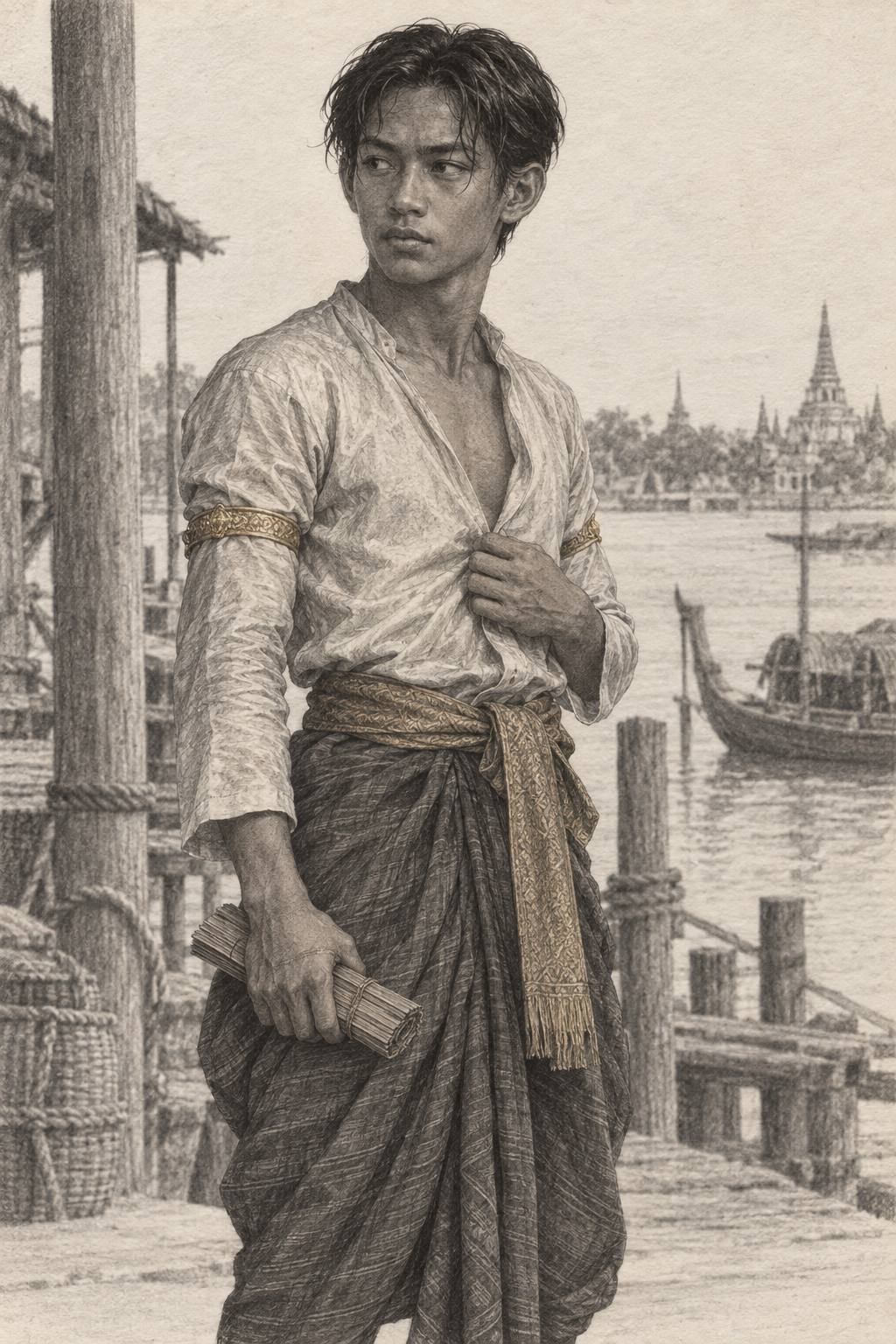
Kirin is Muen Thep and Nang Malee’s son, raised beside the waterways at Hantra. Calm, observant and reluctant to fight, he is ambidextrous and shorter and slighter than Chai. His father is a decorated officer of modest means; Ta Mun is the household’s boatman.
Kirin has a narrow face, dark steady eyes and a wiry frame shaped by paddling and practice. His skin is browned by the river; pale lines cross two knuckles where an old rope burn healed. His hair is dark, simply cut and usually damp at the temples. His stillness makes him seem less strong than he is. When listening, he stops whatever his hands are doing.
Every day he wears a faded cotton lower cloth secured for climbing and rowing, usually with his chest bare during work and a shoulder cloth available for visits. He keeps a manuscript wrapper dry before keeping himself dry. For Wichit's house he wears a borrowed silk shirt, a long silk lower cloth, Malee's gold-coloured family sash and her gold armlets. These are the family's best possessions assembled for one occasion, not a universal betrothal uniform. The armlets need adjusting; the long wrap shortens his stride. He worries about damaging the borrowed shirt more than about looking impressive.
He is kind without announcing it. He fixes an old woman's mooring while answering a different question. He dislikes violence but enjoys outwitting a bully; that enjoyment troubles him after he sees what public shame can provoke. His flaw is secrecy: he withholds painful truths to protect people and sometimes takes away their chance to choose. His long arc is learning that command requires sharing uncertainty as well as making decisions.
Muen Thep about 45
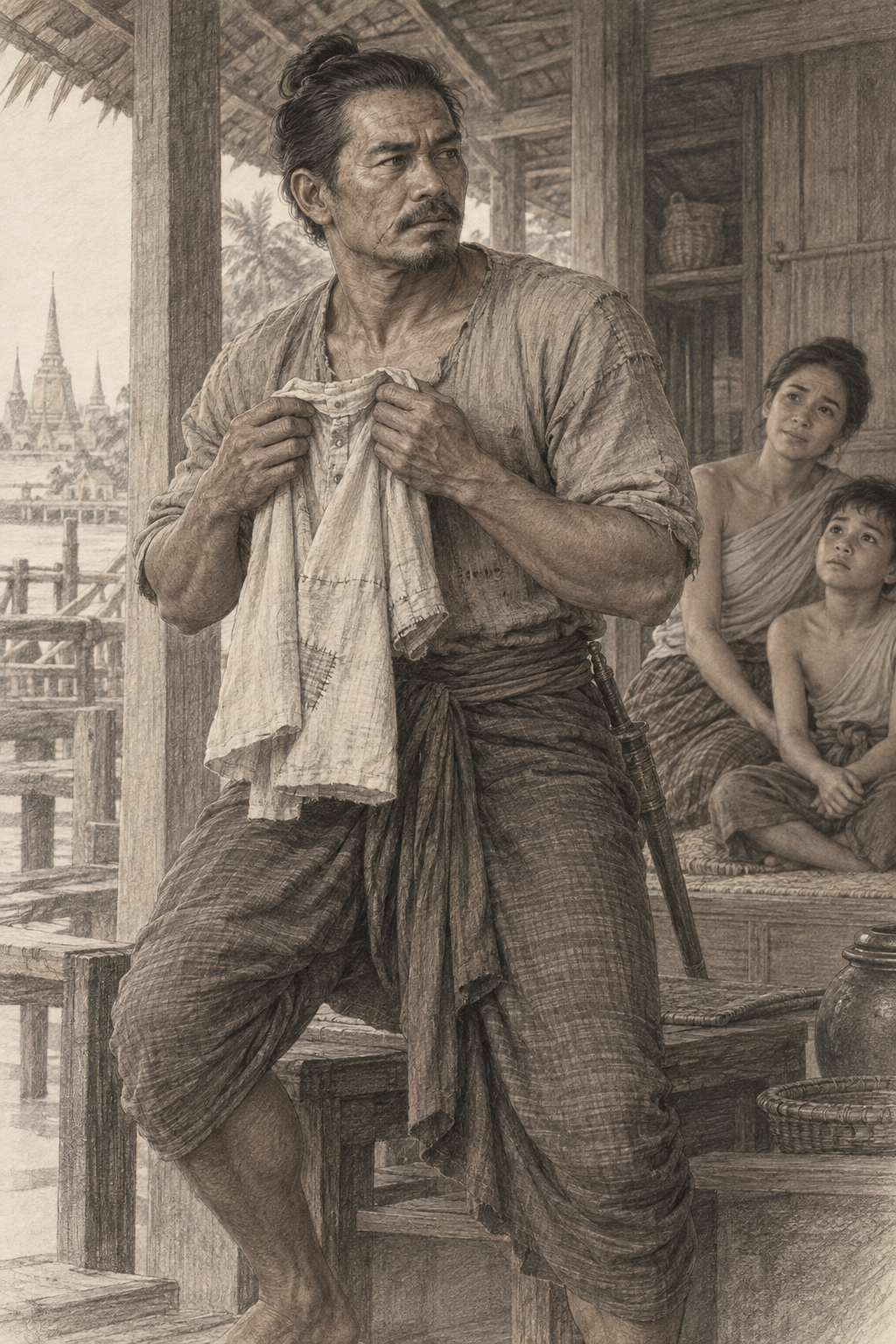
Broad across the shoulders and a little stiff rising from the floor, Thep has a face weathered unevenly by sun and an old scar at the jaw. His hands are careful with chipped bowls. In ordinary life he wears a serviceable cotton wrap and repairs things longer than they deserve. His single treasured shirt, received as a royal reward in the family story, is kept wrapped away. It is clean and repeatedly mended at the collar; its precise historical award form is unverified.
Thep teaches sword and shield because he trusts protection, recovery and keeping another man alive beside you. His objection to paired blades is a personal military judgment, not a kingdom-wide prohibition. He can face an armed charge with steadier hands than he can face a noble who might offer his son a future.
He looks at Malee before agreeing to an expense and at Phet before finishing an old battle story. He mistakes endurance of insult for protection of his household. At the duel his apology and his faith in Kirin must both be visible. He loves his son; his obedience still hurts him.
Nang Malee about 40
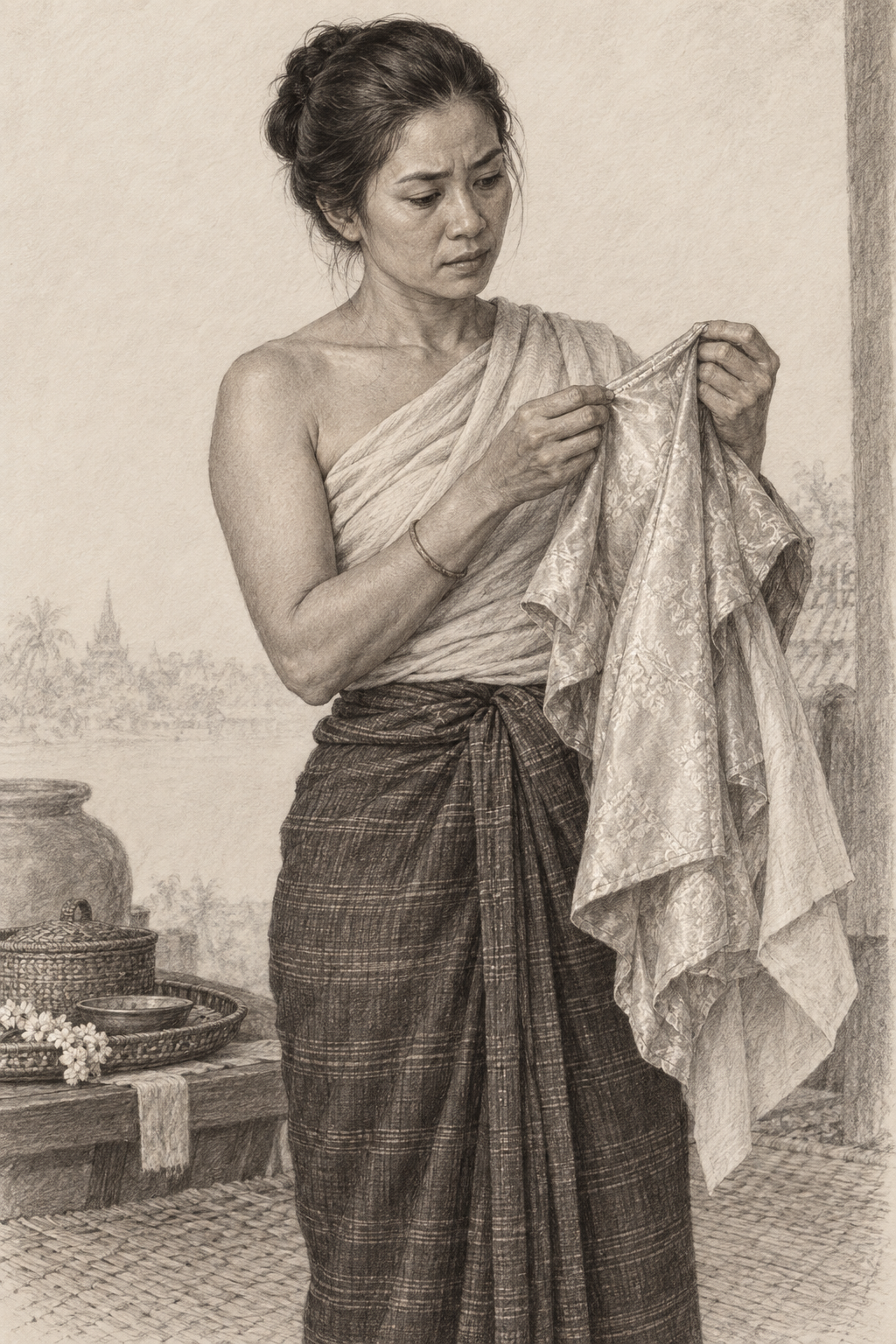
Malee has an upright bearing, strong brows and eyes that follow whoever has stopped speaking. Her hair is pinned securely for work; the precise arrangement is a design choice. Her palms are rougher than visiting ladies expect. She can make a patched mat and a carefully placed tray look like a prepared room.
At home she wears a washable lower cloth and a plain shoulder cloth, tucking it securely when she cooks or lifts things. For the visit she brings out silk and a restrained ornament, letting Kirin wear the more conspicuous family pieces. She checks the borrowed shirt's seams and folds its wrapper for the return journey. Her elegance is attention, not abundance.
Her marriage was arranged after Thep's military service in the family backstory; she must have a remembered opinion of that arrangement. Love grew through his conduct, rather than being proof that being awarded as a wife was harmless. She reads debt, deference and silences faster than Thep does. The prank wounds her judgment as well as her pride. Later she should make material decisions about household goods and evacuation, not merely wait to be rescued.
Phet late forties
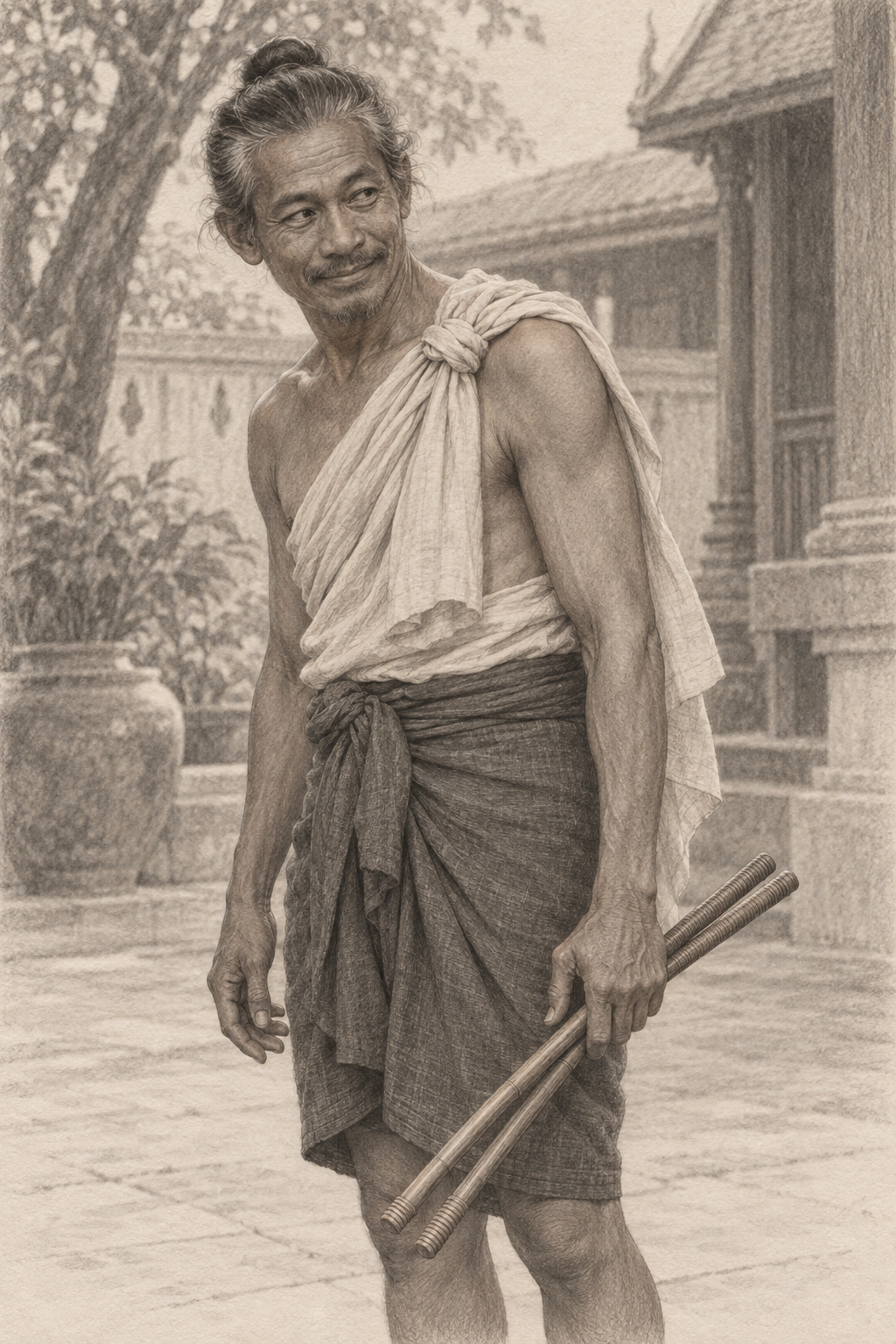
Phet is lean, slightly stooped when standing at ease and unexpectedly balanced when moving. Grey has reached his temples. His smile tends to one side, and one thumb is thick from an old injury. His plain wrap is short enough for work; on a formal visit he adds his best clean shoulder cloth and takes particular care with the knot. He has no theatrical assassin costume.
He keeps practice canes smooth and notices when Kirin favours one leg. He speaks to the boy as an equal in private and remembers the difference in public. He taught Kirin's left hand from the age of six, after seeing him catch equally well with either hand. He also taught him a dual-sword style that Kirin can adapt to paired short sticks, making him exceptionally hard to face at close range. Yai Chan knows; Thep does not. Kirin's strength is not just speed but the patience to arrange the ground on which he can use it.
In the household's account, Phet disobeyed an order, saved a flank and faced a rattan punishment. Thep interceded and paid a sum; Phet thereafter entered debt service. The exact legal route and sentence remain fictional reconstruction, so omit a supposedly sourced number of strokes. Gratitude does not remove the coercion of dependency. A future scene should allow Phet to explain what staying has cost him.
Yai Chan Noi and Ta Mun
Yai Chan
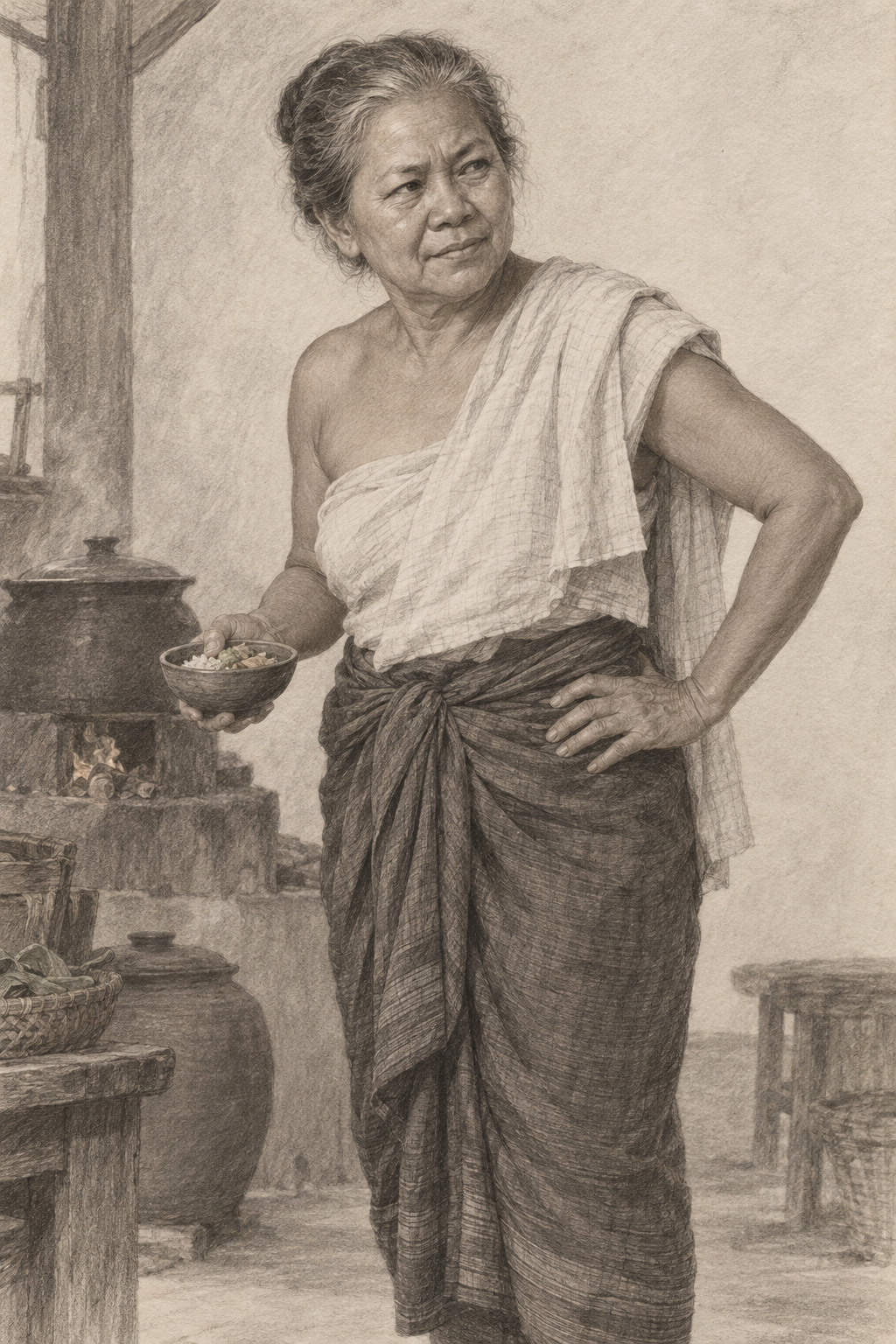
Yai Chan is small, solid and impatient with waste. Her greying hair is tied back, her lower cloth softened by washing, her shoulder cloth always ready for a hot pot or a child's wet face. She raised Kirin and can stop his clever evasions with his full name. She moves the hidden canes before anyone asks and keeps a separate portion of food for someone arriving late. Warmth does not mean she has unlimited freedom to leave service.
Noi
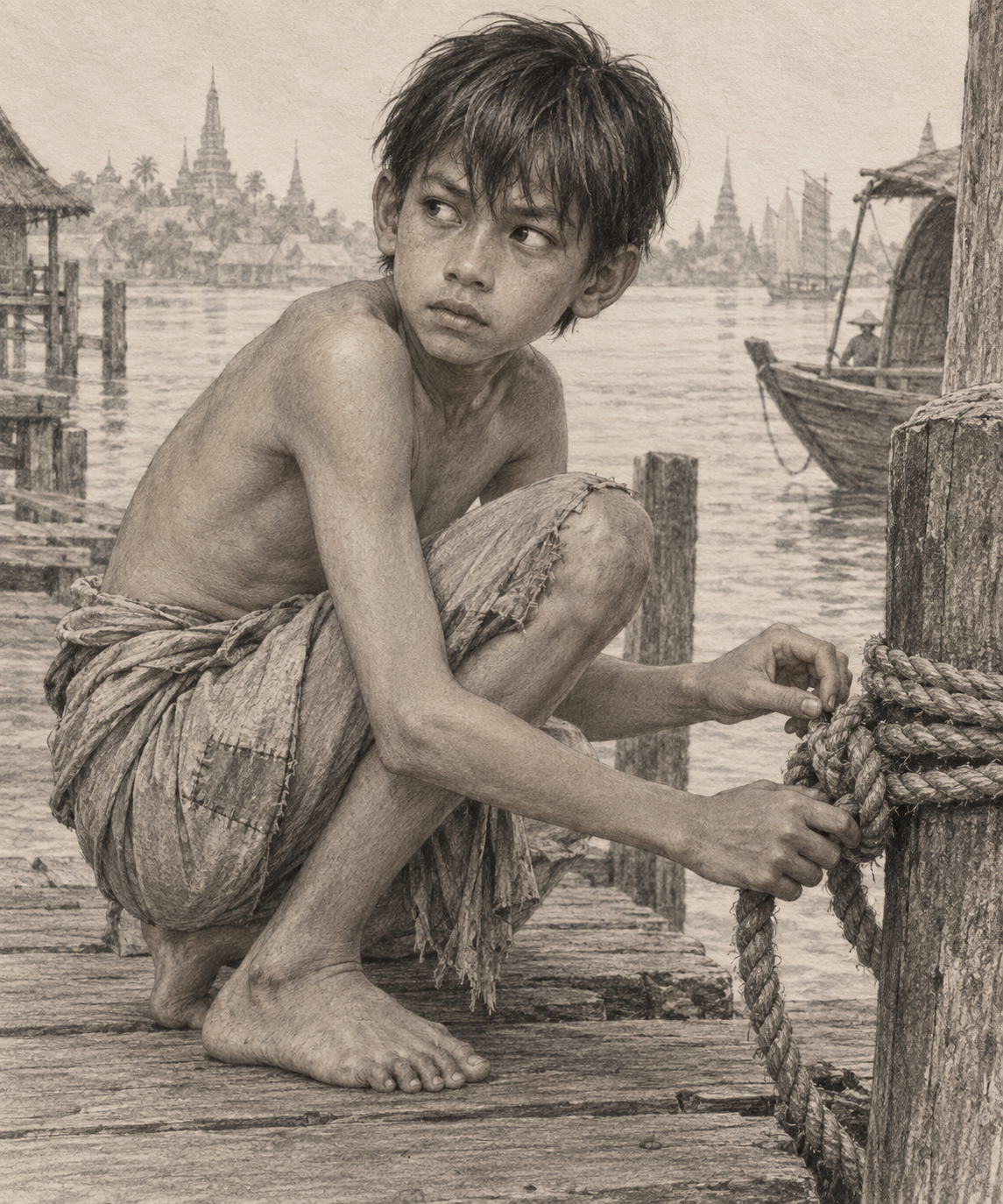
Noi, about twelve, has sharp elbows, an uneven fringe and feet that seldom stay still. He wears plain, repaired cotton. Around Sorn he stops moving. Give him a skill beyond vulnerability: he remembers boats by their knots and can tell Ta Mun which craft arrived while the adults were talking. Do not require him to be grateful for every rescue or risk him merely to demonstrate Kirin's virtue.
Ta Mun
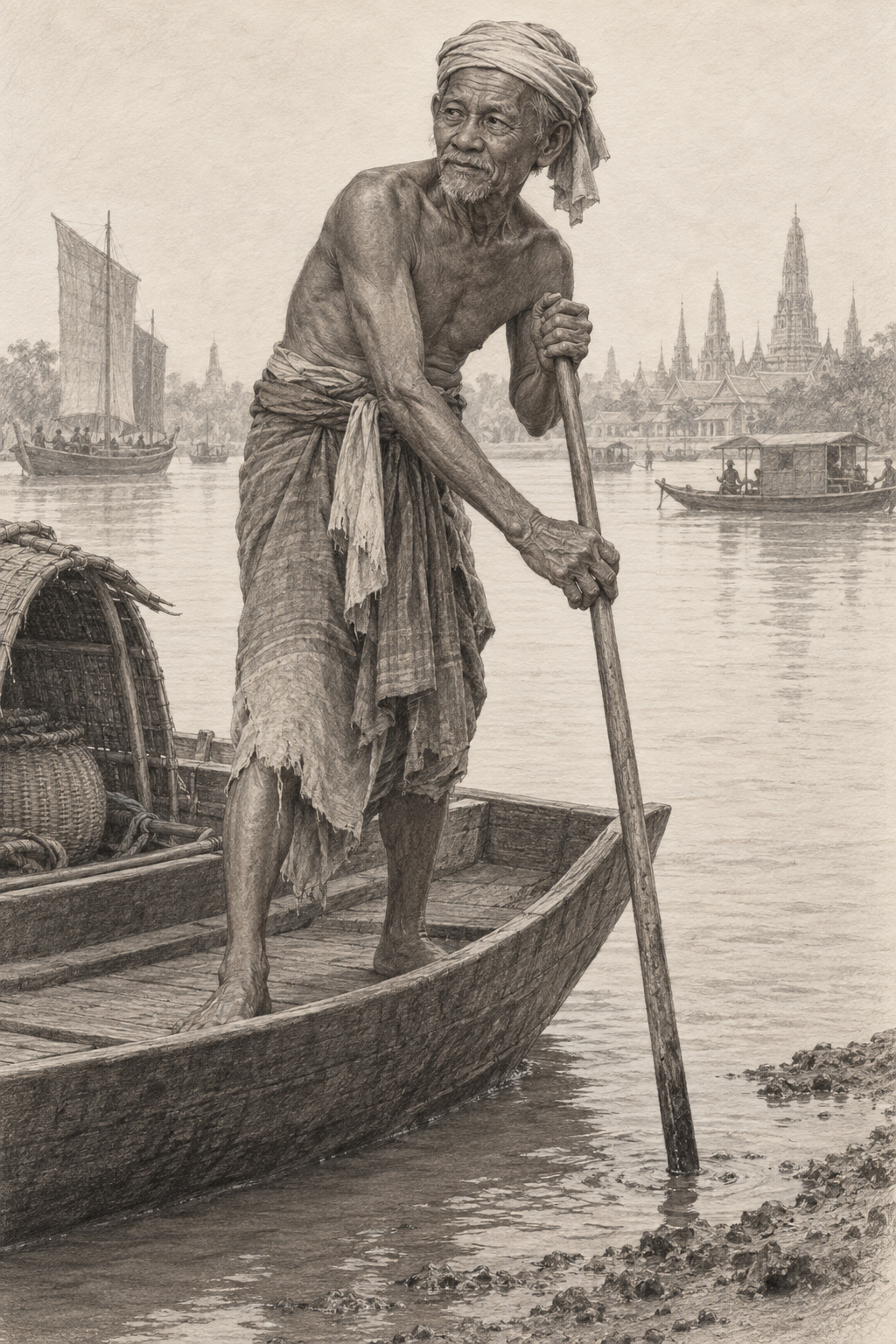
Ta Mun's back is bowed on land but settled in a boat. His hands are enlarged at the joints, his grey hair cropped close by practical preference. He wears a faded wrap and a headcloth in glare. He tests a landing with his paddle before letting Malee step out. He knows gossip by routes and timings, not by magically knowing every secret.
Luang Wichit about 50
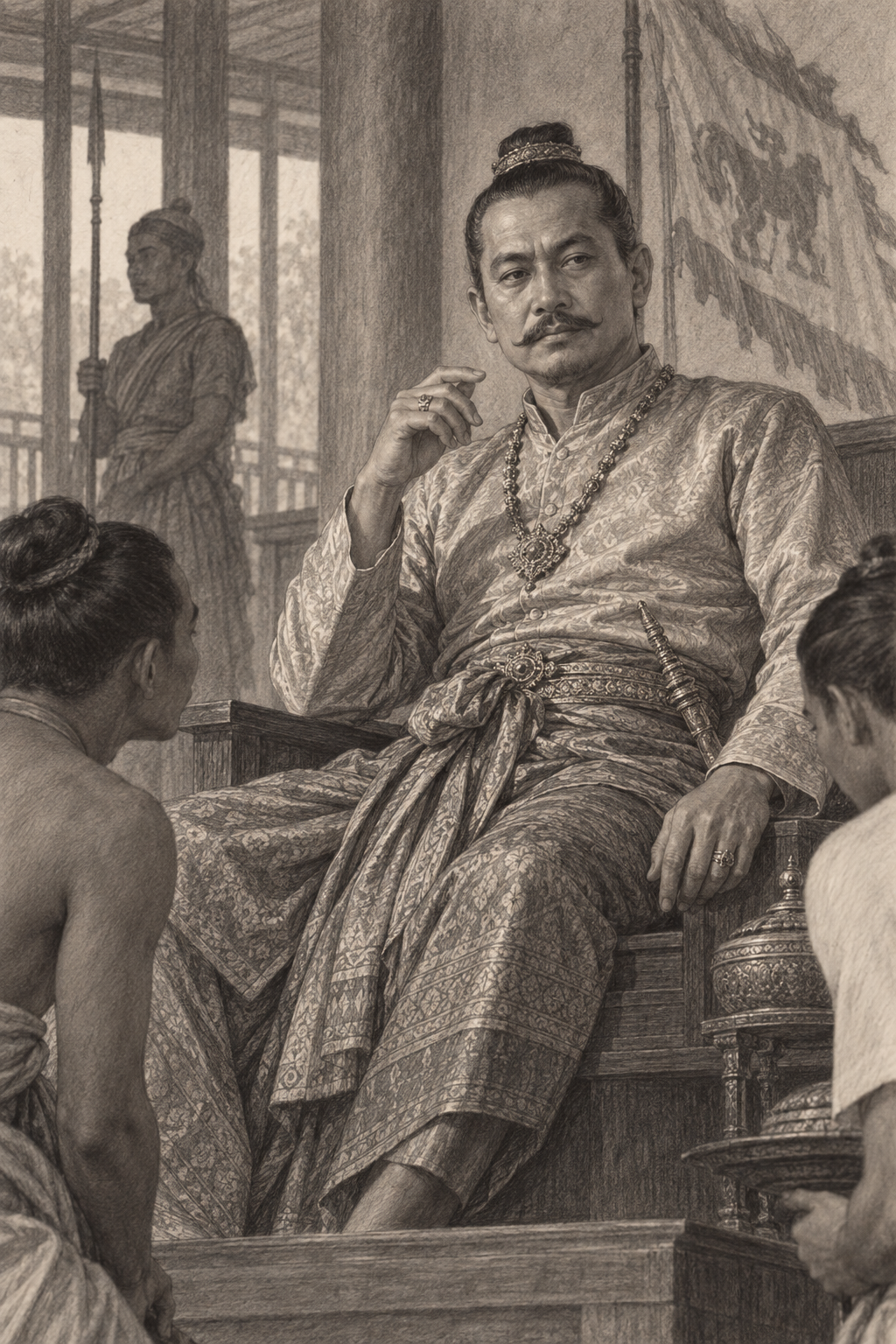
Wichit has a carefully tended moustache, a full face and a stillness maintained by other people's labour. His silk sits smoothly because a servant attends it. Indoors he wears conspicuously fine cloth and an ornament chosen to make visitors remember his standing. Campaign dress should look maintained, even when his men lack replacements.
He speaks softly enough to make an inferior lean closer. He waits before acknowledging Thep but rises immediately for Ong. He displays a captured standard and retells Thep's deeds with himself at their centre. His dependence on the merchant makes the cruelty purposeful: he uses the family as entertainment and Kirin's service as an asset. He fears a witness who can connect dates, names and surviving records more than he fears an angry accusation.
Nang Somjit about 45
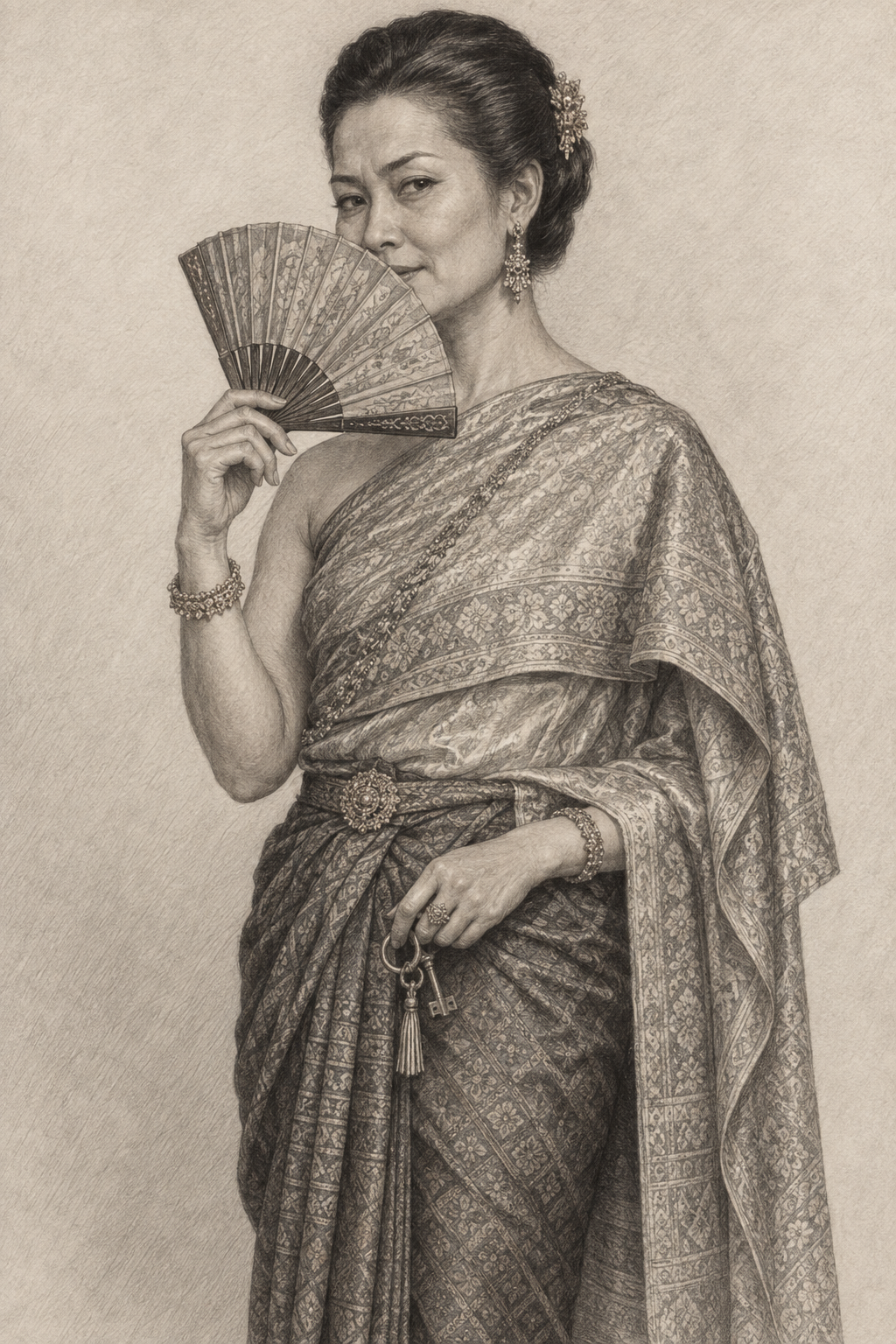
Somjit remains a provisional personal name. Wichit's wife has quick eyes, a precise smile and a fan she uses to decide how much of her face a room may see. Her formal cloth is richer than Malee's; at home she wears a less elaborate wrap but never seems caught unprepared. A key or household tally lies within easy reach.
She sends the misleading message. It is a test of who can be made to obey and a performance for wealthier guests. She enjoys humiliating an aspirant family, but she also understands the financial fragility behind her husband's display. She straightens Mukda's cloth while overruling her. This maternal gesture makes the control more intimate, not more excusable.
Chai age 18
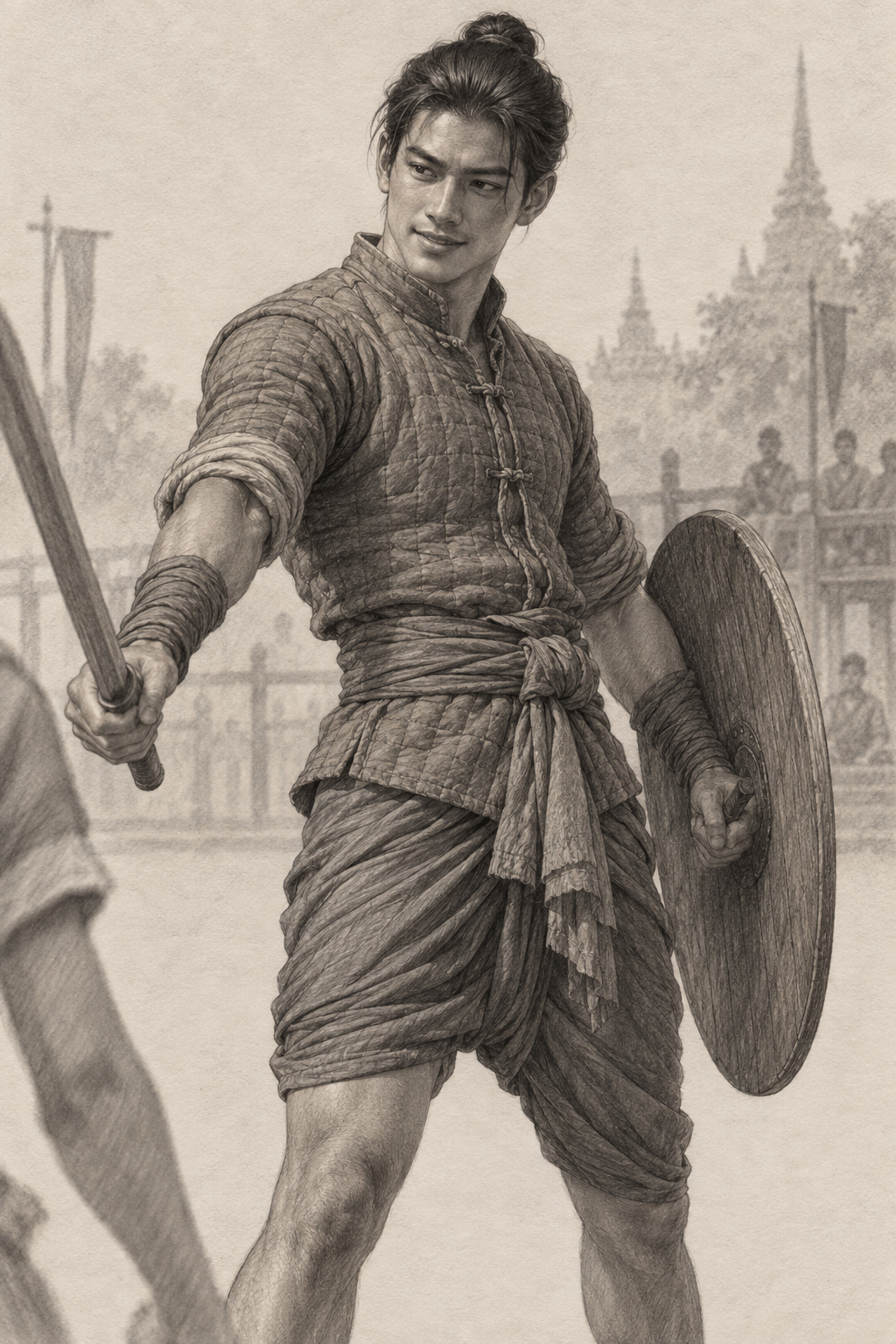
Chai is tall, long-limbed and very quick, with a straight-backed ease that has been practised as carefully as his swordwork. His dark hair is kept out of his eyes; he looks directly at the person he expects to impress. His drill outfit is a tightly hitched lower cloth, a fitted padded cotton jacket and secure bindings, all design rather than an attested standard uniform. At a feast he can choose richer silk without looking uncomfortable in it.
He has real ability. His two festival victories and defeat of a palace-guard instructor at sixteen are fictional local achievements. Let him adjust a junior's stance correctly before he insults Kirin. His flaw is his dependence on an audience: he turns a sparring exchange into a punishment when dignity feels threatened. He and Sorn are friends as well as beneficiaries of rank and money; humiliating Sorn gives him a personal reason to lose control.
Sorn age 19
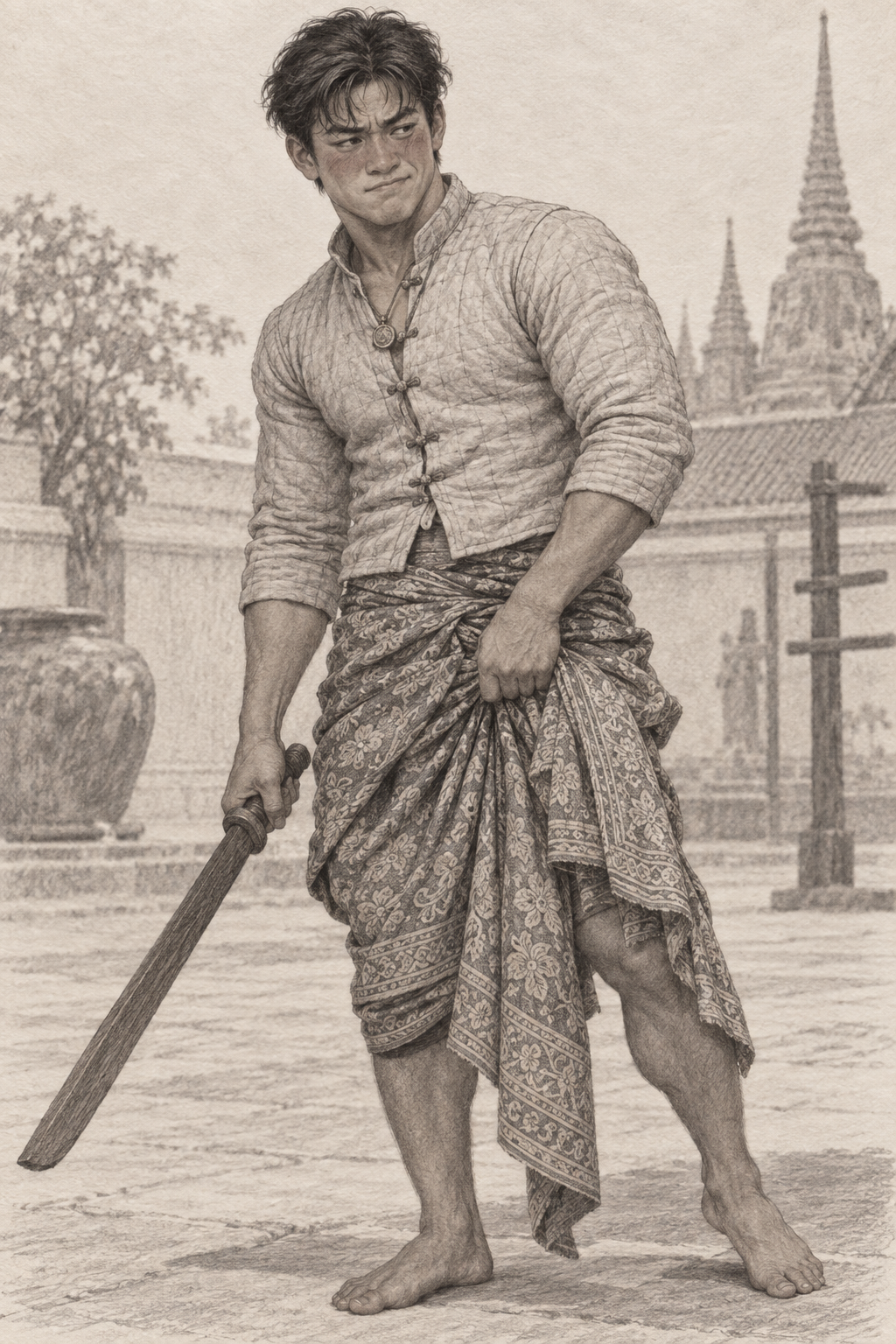
Sorn is thick through neck and shoulders, heavy on the front foot and stronger than his technique deserves. His face flushes when laughter turns against him. He wears an expensive Indian-patterned lower cloth loosely hitched, a padded drill jacket and an ornament he has been told to take off for practice. Imported cloth is historically plausible; this costume and its careless fastening are design. S3
He pulls at the wrap's loose tail and cracks his fingers when uncertain. He enjoys seeing Noi anticipate a blow. He is an ordinary swordsman with dangerous strength at close range, helped by adults who decline to enforce rules. The pond joke ends with Kirin offering his cloth back. Stage it through his fall, splashing water and reactions, with no need for an explicit view of nudity.
Setthi Ong and his wife about 50 and 45
Setthi Ong
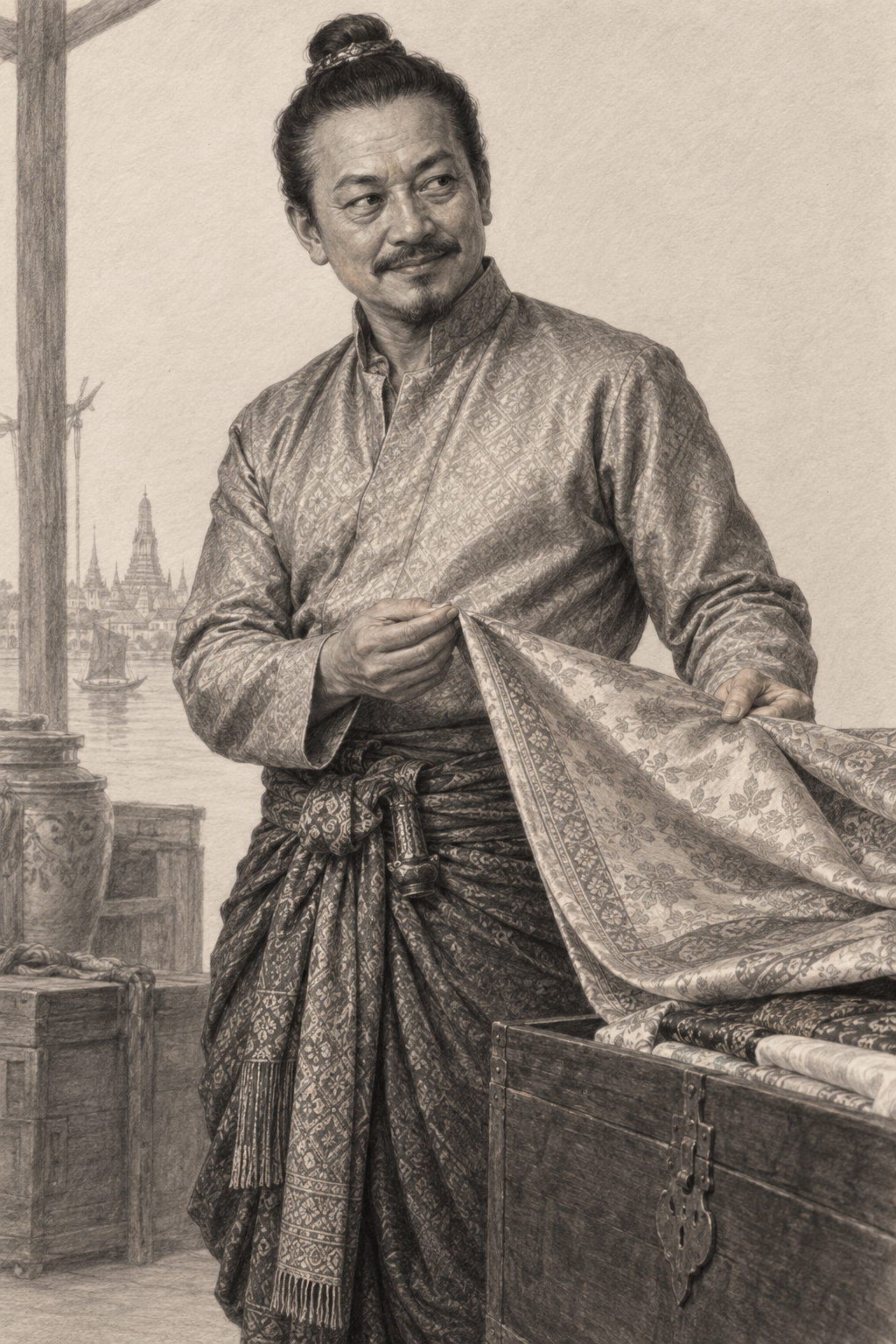
Ong has rounded shoulders, alert eyes and immaculate fingernails. He handles cloth by its edge, protecting it from oil. His everyday clothes are quieter than Sorn's; for the visit their material carries the expense. Setthi is used as a wealthy man's designation, not a rung in Kirin's military promotion path.
Ong's wife
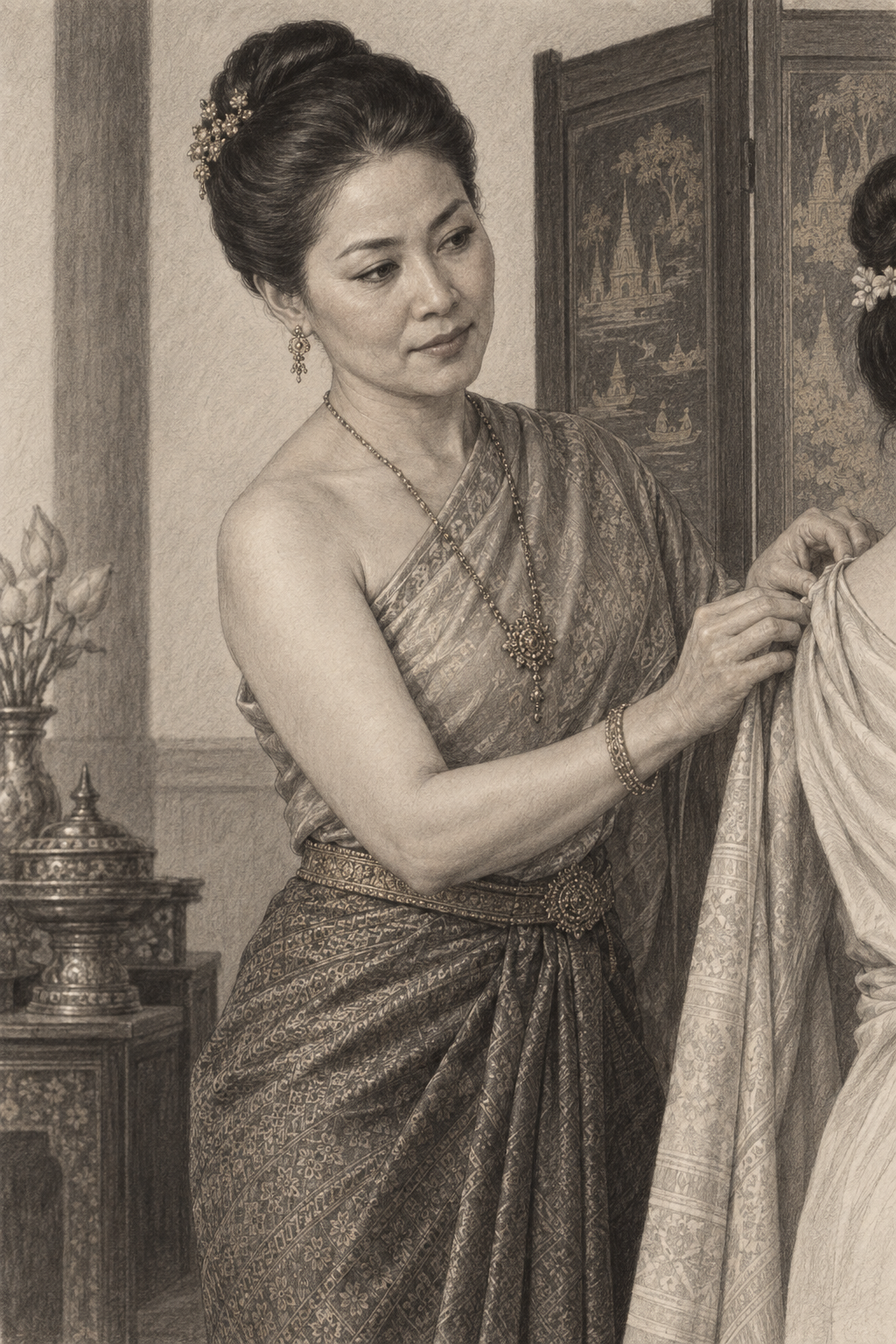
He knows exactly when to laugh with Wichit and when to let silence remind him of a debt. His wife, still unnamed, is composed, beautifully dressed and attentive to every sign of resistance from Mukda. She speaks of arrangements as though consent is already settled. Give each a different priority: Ong wants enforceable obligations; his wife wants admission to a household that has looked down on hers.
Mukda age 16
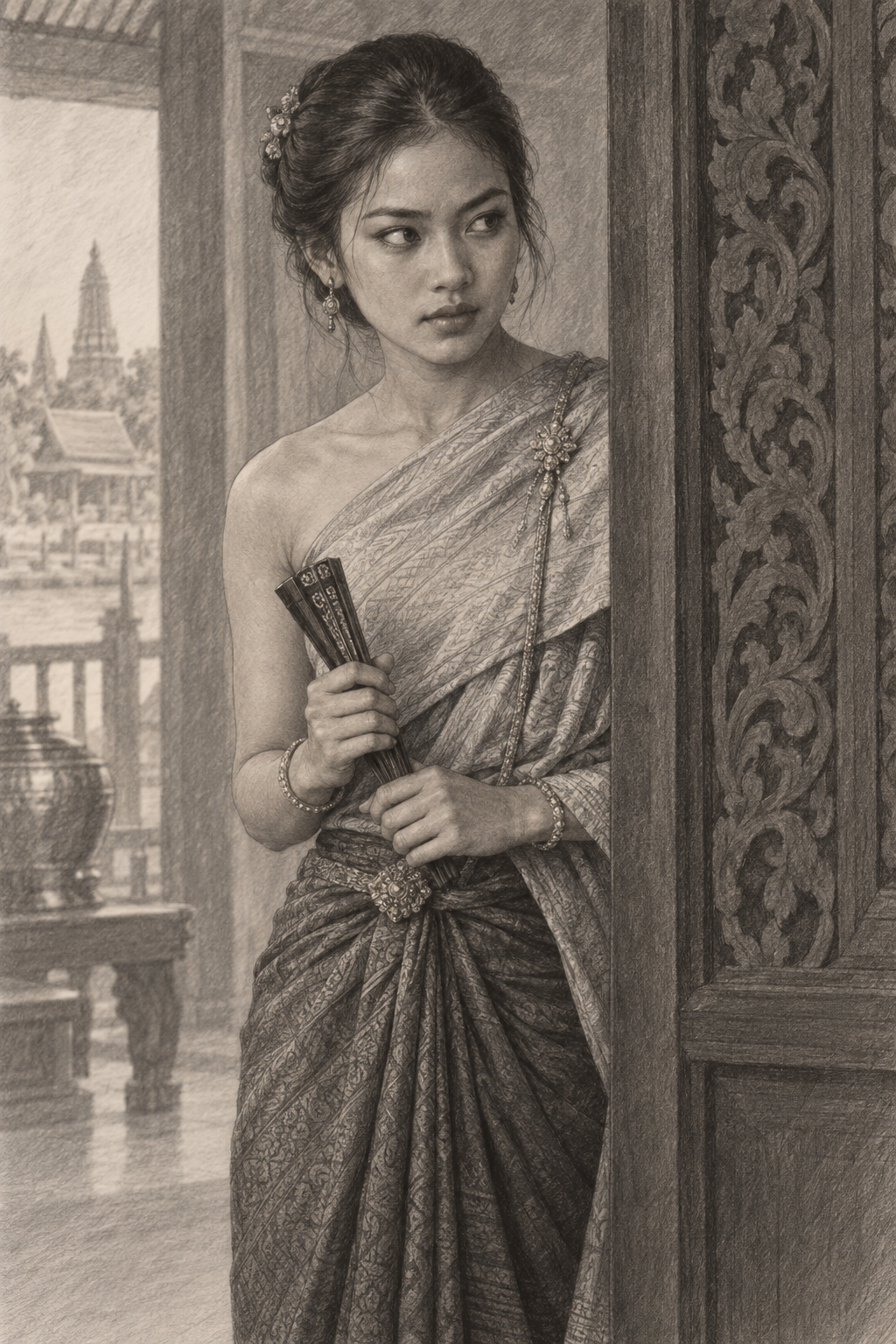
Mukda has dark, attentive eyes, an oval face and an expression that becomes animated when she forgets she is being watched. Her hair is dressed simply enough to live in, with the exact period form awaiting costume review. Her beauty is a reputation spoken by others; the camera introduces what she notices.
At home she wears a fine lower cloth and a secure shoulder cloth, with light jewellery. For a formal reception she adds richer silk and a carefully chosen ornament. When she travels by covered boat, a plain outer cloth and the canopy shield her from sun and attention. Her maid knows that she watches people at landings rather than admiring shop goods.
For years she has noticed Kirin around the city, although he has never noticed her. She has seen Kirin help elders, speak to dependants without condescension and quietly spoil a bully's plans. She is interested in his conduct before she knows his talent. She dislikes the men paraded before her and resents the bargain with Sorn. She first snaps her fan closed at the marriage hint, then later forgets the fan altogether when Kirin keeps blood on his hand. In later acts she can preserve a message, cultivate her own allies and refuse a plan made in her name. Romance, if developed, requires reciprocal knowledge and choice; she is not the prize for winning a duel.
The wider circle
Bua
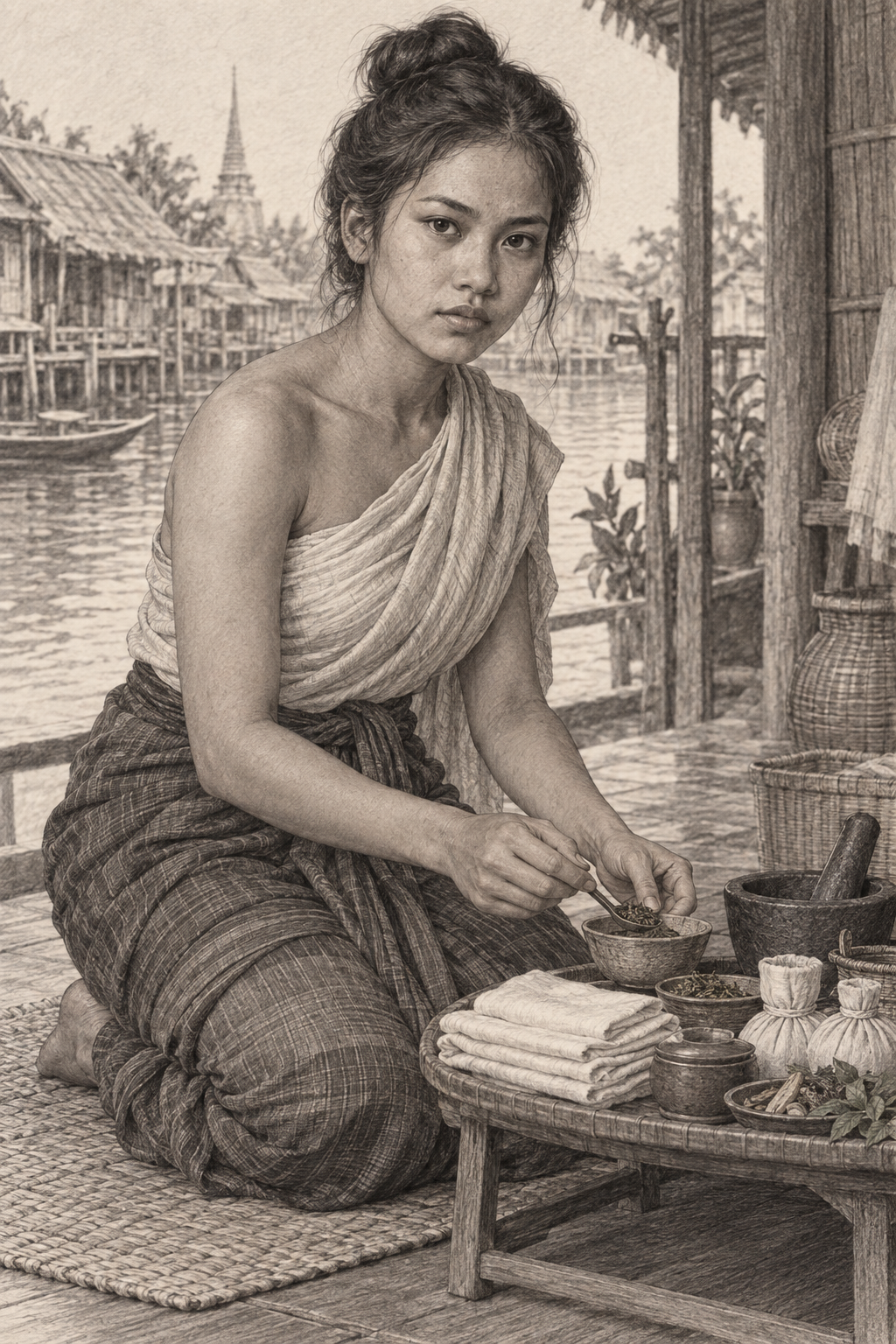
Bua, a healer's apprentice of Kirin's generation, has strong hands, a direct gaze and practical cotton clothes secured for work. She keeps spare clean cloth dry. She is a neighbourhood friend, not his sister. She can refuse Kirin's priorities when another patient needs her more; her skill does not make infection or injury trivial.
Old Boonma
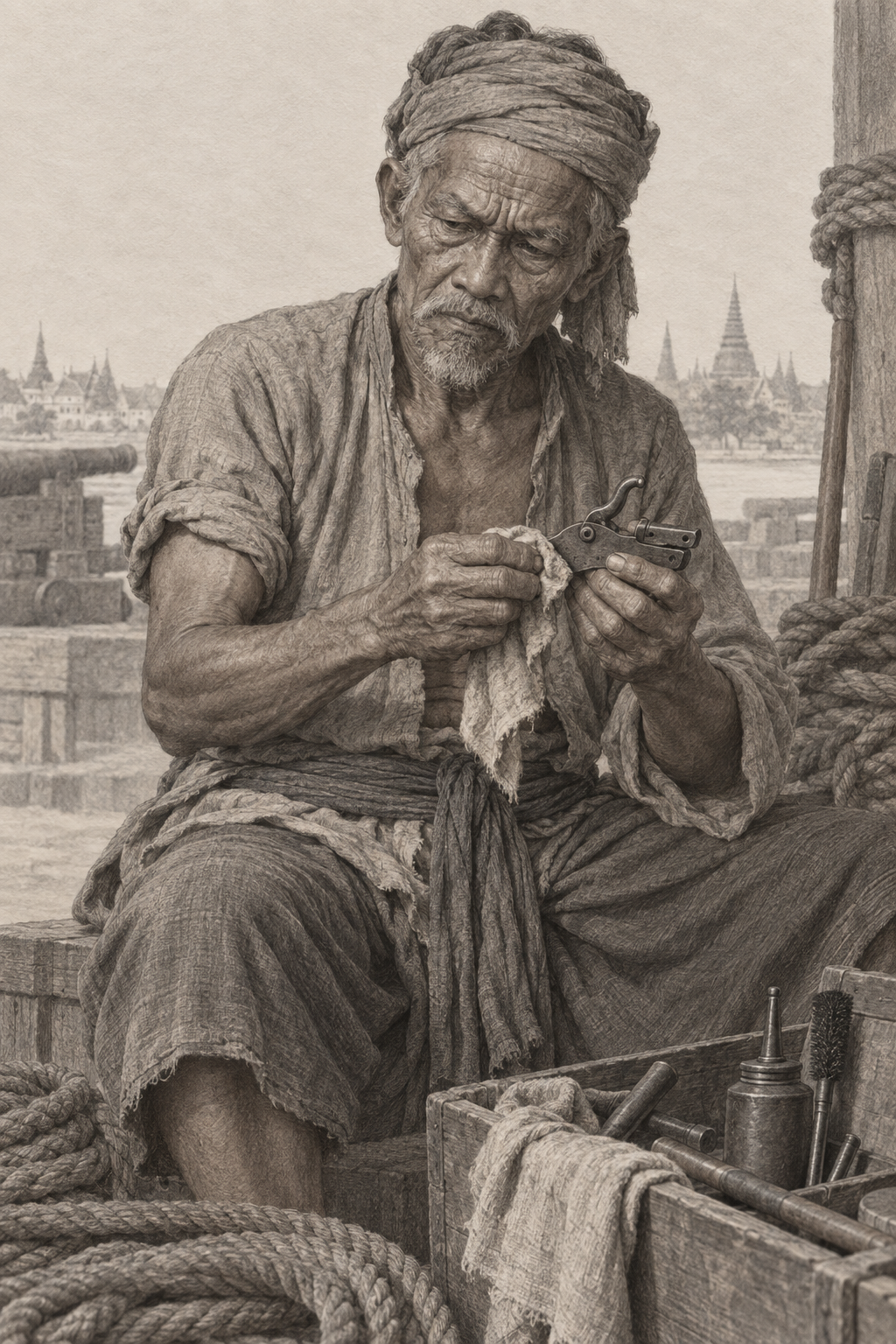
Old Boonma is a retired gunner with a narrowed hearing range and one sleeve habitually rolled higher. His faded clothes smell of stored rope and oil. He makes Kirin carry, clean and account for equipment before allowing a shot. He teaches firearms without claiming that all gunpowder knowledge arrived with one nationality.
Diogo Ferreira
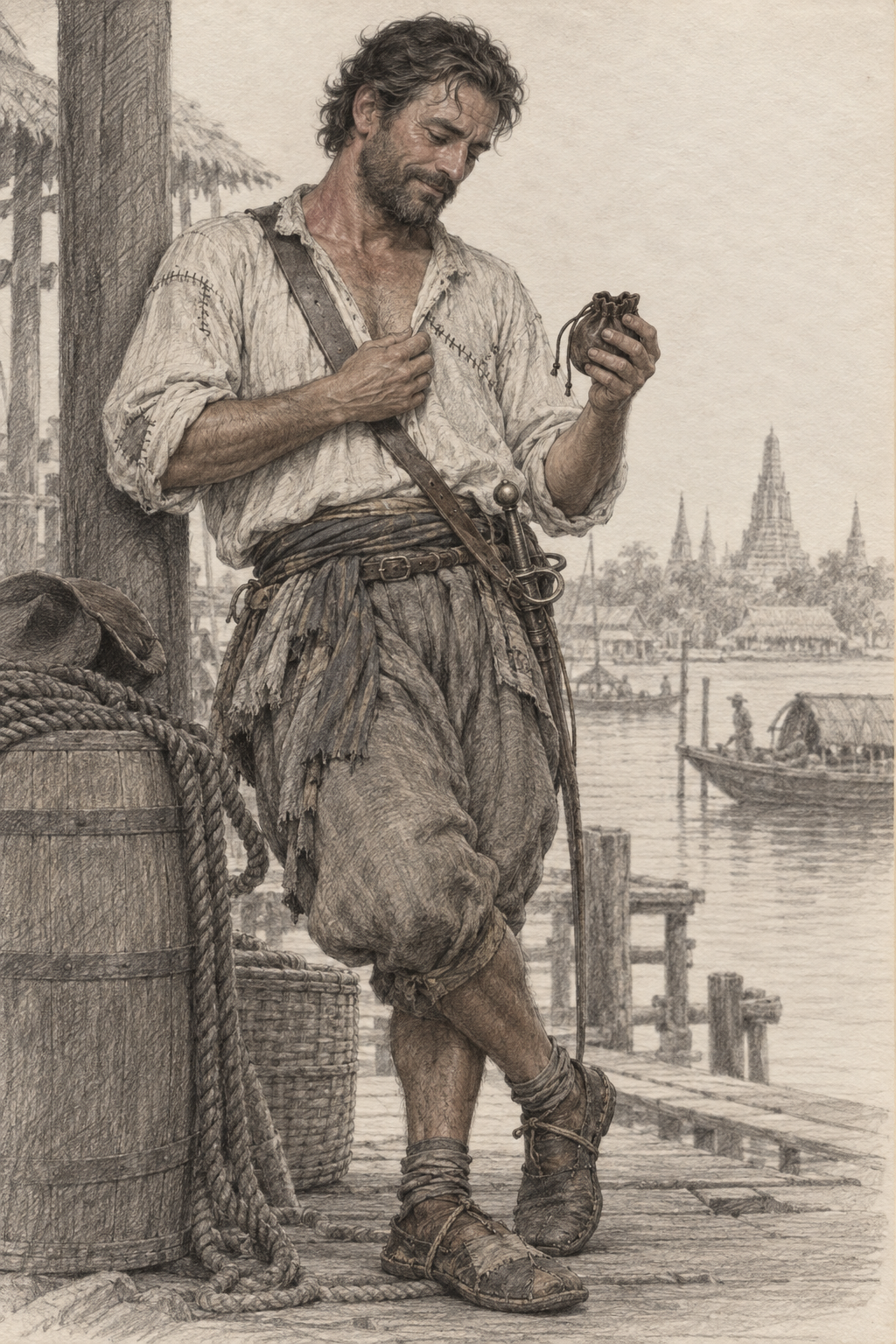
Diogo Ferreira is a fictional Portuguese mercenary with a sun-reddened neck, a repaired linen shirt and footwear patched for wet landings. He dresses for climate and pay, not as a later colonial officer. His humour conceals anxiety over wages and dependants. A choice between employers can threaten Kirin without making Diogo's nationality a moral explanation.
Lian
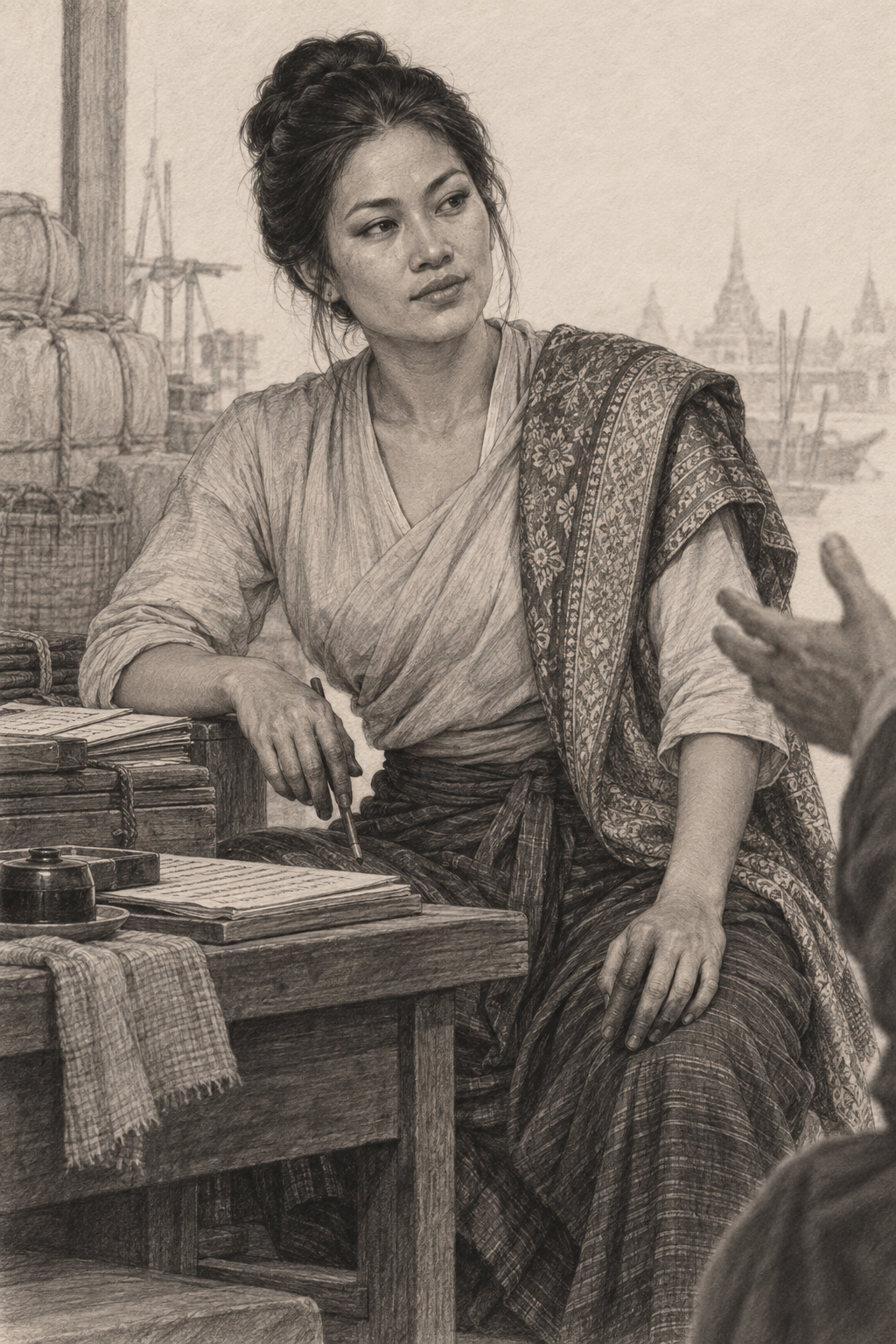
Lian, a fictional broker in the southeast trading district, has a patient face and fingertips darkened by work with records. Her working clothes are plain and practical; she brings out an excellent imported cloth for a negotiation. Her age is approximately thirty by design. She lets a customer finish a bad argument before naming its cost. She has obligations to kin and workers that Kirin cannot purchase away with a single favour.
Khun Anan
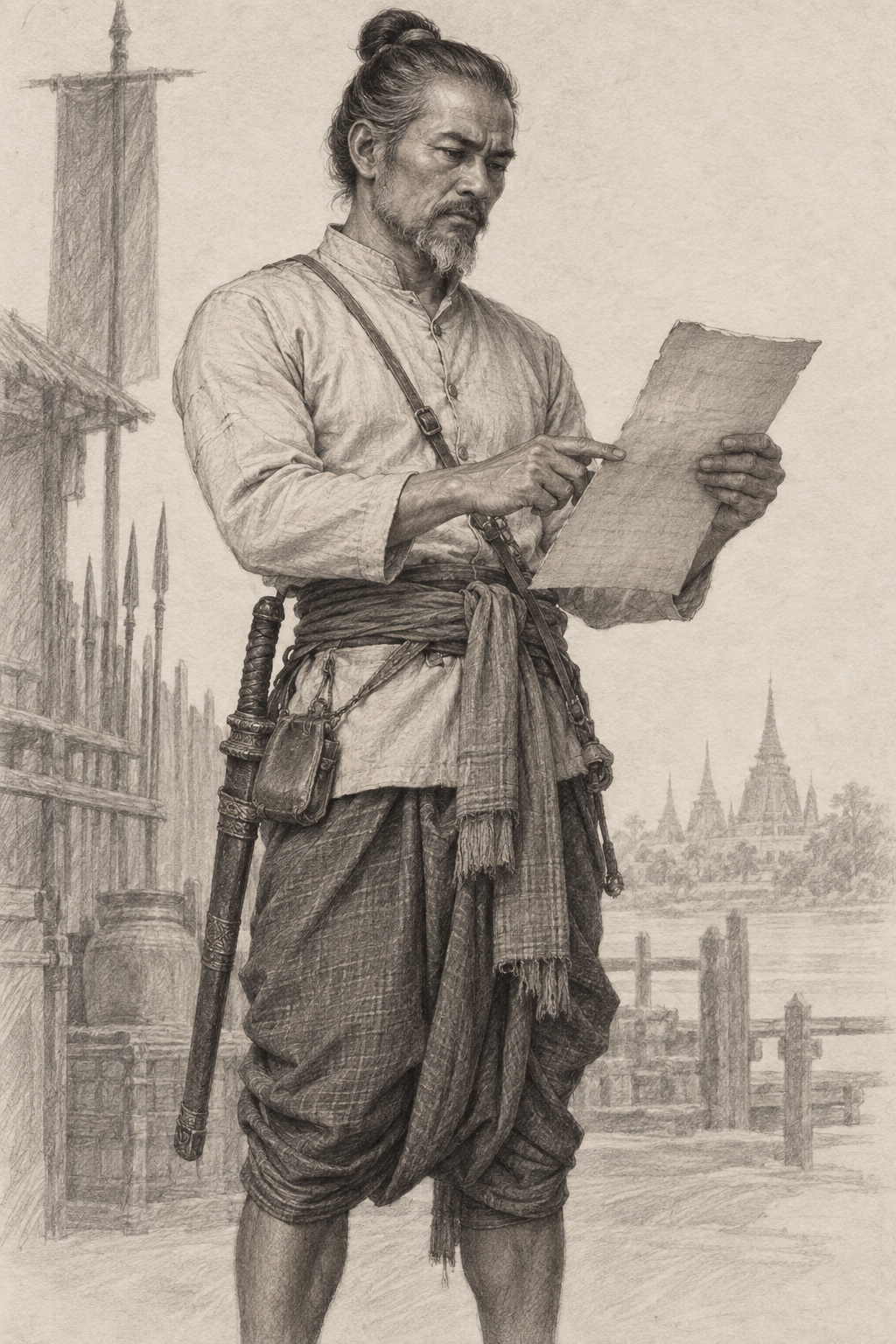
Khun Anan, Kirin's eventual patron, is an austere middle-aged officer with a greying beard and meticulously repaired kit. He gives precise orders and expects their human cost to be reported. His patronage opens doors but makes Kirin answerable for another household's interests.
Nai Sak
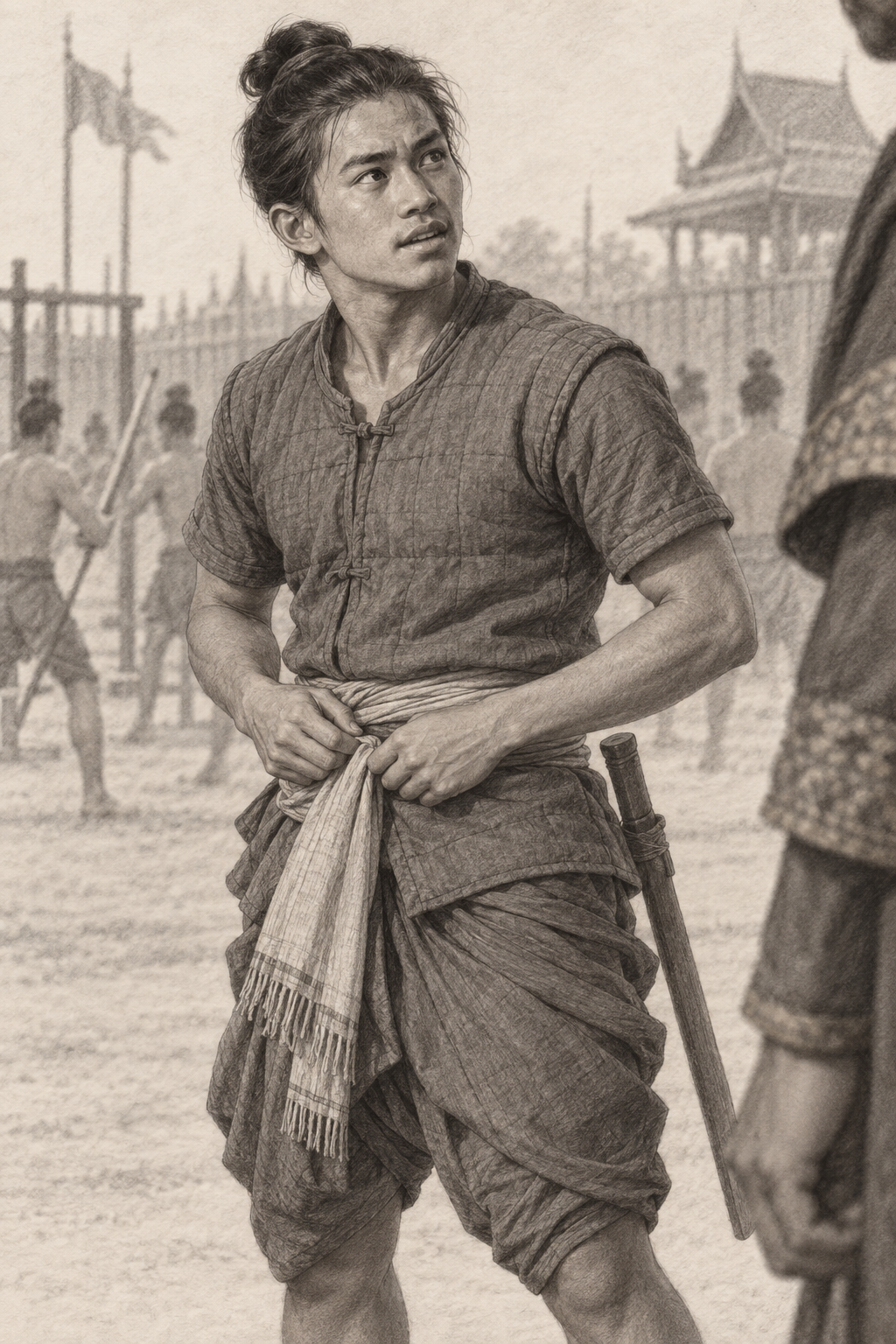
Nai Sak, a young trainee, is compact, restless and forever straightening a clean but inexpensive sash. His ambition resembles Kirin's need for security without Kirin's gift. He can become a reliable comrade or an informer according to how the player shares credit, food and risk.
Thura Kyaw
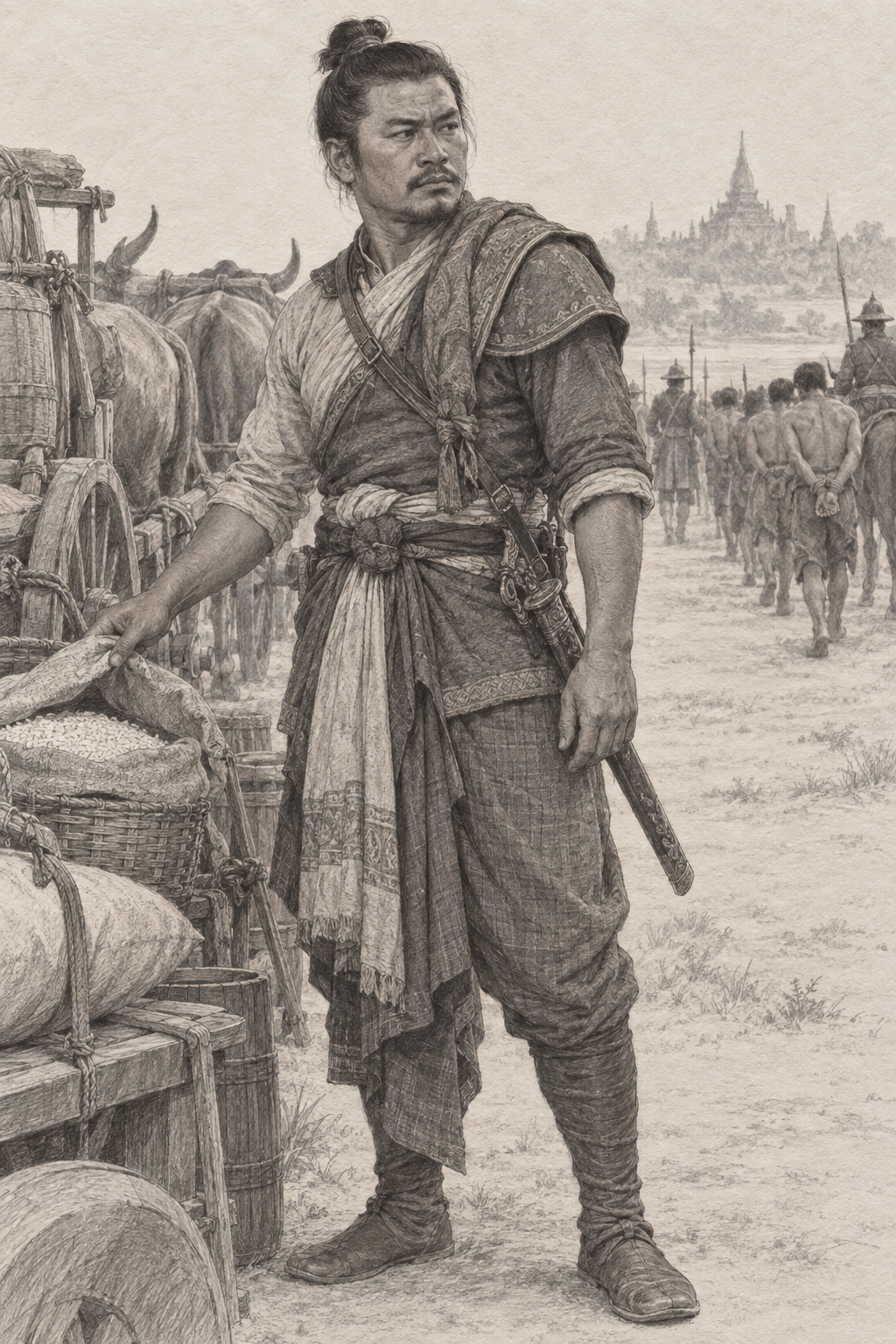
Thura Kyaw is a fictional officer serving Bayinnaung, in his thirties, broad-faced and economical in movement. His equipment is worn and maintained; exact arms, clothing and the name's period suitability need specialist review. He checks food and transport before prisoners. He may be ruthless without being irrational, and Kirin may recognise his own command decisions in him.
Historical people
Maha Chakkraphat, Mahinthrathirat, Bayinnaung, Maha Thammaracha and Setthathirath remain historical actors. Their appearance, private dialogue and screen presence would be interpretation, not eyewitness reconstruction. Naresuan may be mentioned in the hostage context; do not send both brothers on a confidently dated journey on the strength of the earlier unsourced draft. Phraya Chakri's betrayal belongs to chronicle tradition and must be framed accordingly. A fictional accomplice can carry a player confrontation without assigning the player power to kill a historical figure whose later fate is not settled here. S2 · S7 · S10
4 Chapter 1 The Visit
One day late in the rains of 1563. The exact month is a production choice; the white-elephant dispute precedes the campaign. All dialogue, training rules and household events are fiction. The chapter teaches movement, observation, distance and defence while making the player care about a family. Nang Somjit deliberately misleads Kirin’s parents with a false betrothal invitation. Borrowed silk and family gold leave him overdressed against two men prepared for drill; the prank attacks the whole household, especially Thep’s hope that service will finally earn respect. Historical support and remaining uncertainty are recorded in the review.
1 Dawn over the island
A slow aerial shot at sunrise: mist on the rivers, the three chedis of Wat Phra Si Sanphet catching the light above living roofs, junks at anchor, small boats on the canals. The camera drifts east across the eastern waterways to a stilt house among palms at Hantra. Title card: Ayutthaya, the end of the rains, 1563.
2 An empty mat
Nang Malee finds Kirin's sleeping mat empty on the most important morning of his life. Thep stiffens. Phet, rinsing two rattan canes he quickly hides behind the woodpile, says he sent the boy to the landing for fresh betel leaves. It is a lie, and everyone except Thep knows it. Play: none; the player watches the family work as a unit.
3 Paddling home
The player takes control of Kirin in a small boat on the canals, late, with a basket of fresh betel leaves: buying them is his habitual apology for being late. Neighbours call to him. He helps an old woman lift a water jar and returns a lost chicken. Under his arm is a palm-leaf manuscript borrowed from a monk. On the eastern approach, a covered boat drifts past: Mukda and her maid, back from the market. She watches him lift the water jar; she has watched him before. He never looks up. An optional camera detail reveals her to the player; Kirin does not register her. This camera detail is not entered in his knowledge journal. Play: canal traversal and greetings. Kirin reads: a lame veteran at the landing tells him another piece of the story of a Cambodian campaign in Thep’s past. Kirin asks one quiet question: who gave the order to retreat?
4 Dressing for the house of a noble
Two days ago Nang Somjit sent word that the Luang would receive the boy for Mukda, and that he should come dressed as a groom’s family comes. Malee has borrowed a silk shirt and unpacked her family’s gold sash and armlets. She wraps Kirin in a long silk lower cloth, adjusts the armlets and checks a loose stitch in the borrowed sleeve. He can barely bend his knees. Phet looks at the outfit and says nothing, loudly. She drills him: enter on the knees, keep your head below the host's, never point your feet, accept betel with both hands, speak only when addressed.
Thep keeps interrupting with contradicting advice. Malee laughs: she has seen him face Burmese cannon calmly, and this is the first time she has seen his hands shake. Thep admits he hopes Wichit is finally repaying an old debt. Malee says nothing. Play: short dialogue choices that deepen each relationship.
5 Phet's advice
At the foot of the ladder, Phet adjusts Kirin's sash and says quietly, "In a great house, watch the servants' hands, not the master's face. They know the weather before he does." This introduces the Observe mechanic.
6 A meal to remember
Rice, a fish curry warmed with pepper and galangal, and a shrimp-paste relish, eaten by hand from earthenware. Thep tells an old war story; Malee corrects his numbers; Phet corrects both. Yai Chan scolds everyone for eating too fast in good clothes. It is an ordinary family meal, not literally their final meal in the house. This is the scene the player should remember at the end of the game. Malee saves a little curry for a neighbour; Kirin reaches for the same bowl and withdraws his hand when he sees what she is doing.
7 The river
Ta Mun paddles the family to the island past crews practising for the boat races. A fast boat cuts across them and swamps a fisherman: Chai at the prow, Sorn laughing beside him, both wearing padded drill jackets and lower cloths hitched for practice. Ta Mun mutters the city's gossip: Chai has won the sword bouts at two boat-race festivals and beat a palace-guard instructor at 16, and people call him Chai the Lightning; Sorn is as strong as a buffalo and fights like one. Kirin helps the fisherman right his boat and watches the pair head toward the island, Chai returning ahead while Sorn rejoins his parents for their formal arrival. He says nothing to his parents.
8 The Luang's house
A timber house with carved joinery and a raised platform linking its buildings, crowded with servants. The family approaches on their knees, following the host’s servants. This precise blocking is etiquette reconstruction, not a documented 1563 protocol. Servants glance at Kirin’s silk and hide smiles. Nang Somjit looks him up and down from beside her husband, then raises her fan. Gifts are exchanged: Malee's betel set, and from Thep, a Khmer sword he took in a Cambodian campaign. On the wall of the great room hangs a Khmer standard. Wichit tells the story of how he captured it. It is the story Thep told Kirin as a boy, with the names changed. Thep lowers his eyes. Malee's hand closes on her husband's sleeve.
Behind a screen, Mukda watches. Observe: the best betel set is being kept back for another guest.
Behind the screen, Mukda recognises the boy from the canals. She remembers the day Sorn's gang tormented a fish-seller's son on the bank, and Kirin, unseen, untied their boat so it drifted off downstream while they laughed. She also sees what no one else does: Kirin's eyes following the servant who hides the betel set.
9 Jabs dressed as courtesy
Wichit wonders aloud that Thep is still a Muen after so many years: "The king rewards men who know how to be seen." He praises Malee's family and sighs over how the rain falls where it will. He has heard that Kirin is "quite handy with a stick." Thep answers that his son has been taught properly. Phet's face shows nothing. Kirin's shows nothing either.
10 The news
Wichit tells Thep that the king of Pegu has demanded white elephants and been refused, that travellers bring rumours of trouble near the frontier, and that the king has ordered a count of all able men, with arms and livestock taken for war. Nobles must raise and drill new men.
11 The second family
Setthi Ong, his wife and Sorn arrive; Chai is already at home, and the best betel set comes out for them. Wichit rises to greet the merchant, which he did not do for Thep. Sorn wears a new lower cloth of imported Indian print, loosely hitched by his own vain preference, with its tail tucked carelessly at the back; he hitches it every few minutes. Observe: the loose tail. He laughs at Kirin: “Did someone tell him it was his wedding?” Beside the two young men in drill clothes, Kirin looks like a bridegroom at a sword school. Sorn sees Noi holding the family's sandals by the door and smiles at him; Noi flinches.
12 The joke
Wichit sees the confusion on Thep's and Malee's faces and asks what is wrong. They say they thought Kirin would meet his daughter today. He will, says Wichit, and then he laughs: would his daughter be matched with the son of an officer so far beneath him? This is Wichit’s insult, not a statement that Muen is a commoner’s non-title or that the match is legally forbidden. Setthi Ong laughs with him. Ong's wife says the girl's future is "already being discussed" and looks at Sorn.
Malee looks at Nang Somjit and understands. The message was the joke. Thep, in his treasured shirt, sees it too. Behind the screen, Mukda’s fan snaps shut. Several suitors’ families have sat in this room this year, and she has despised every one; Sorn is the worst.
Both young men, Wichit says, will be enrolled for the war when the rains end, and Chai will take them into his unit. Malee says Kirin is not yet eighteen. Wichit replies that he can find a place for an able boy in his levy, and that if the boy is too young to fight, he can carry Chai's shield. Mukda lowers her eyes.
13 The test
Wichit wants to see these reputations for himself. Malee asks leave for Kirin to change. He waves it away: “A soldier fights in what he is wearing.” Chai grins: “The groom is ready.” Kirin knots the long silk above his knees, cinches the sash and pushes the borrowed sleeves to his elbows. He knows how dangerous a loose fastening can be. Servants bring out adult-length wooden training swords, round wooden shields and a long wooden staff, or krabong. Sorn and Chai choose sword and shield. Kirin unusually selects the staff, noticing a hairline crack near its middle. It gives him reach now and a concealed second use if it breaks. Wichit reminds everyone of Chai's titles and allows the women, Mukda among them, to watch from the veranda. First Kirin against Sorn, then Kirin against Chai. Chai coaches Sorn loudly and within earshot: "Get inside the staff's reach."
14 First duel: Kirin against Sorn
Sorn charges like a buffalo, tearing Kirin’s borrowed shirt at the shoulder as they collide. Laughter first follows Kirin. He regains his distance and turns the next charge aside with the staff; Sorn is strong but ordinary with a sword. Frustrated, Sorn pins the staff with his shield, grabs Kirin's collar and drives his forehead into Kirin's brow, a blow no sparring bout allows.
Blood streams from a cut above Kirin's left eye and blinds it. Malee half-rises. Wichit does not stop the bout: "In war, no one asks for rules." Sorn grins.
Kirin backs away, head tilted, blind side turned away. He shifts his grip on the staff just enough to wipe blood from his brow with his fingertips. He does not wipe his hand clean. On the veranda, Mukda is the only one who notices, and she leans forward. He lets the staff sag on the blind side and stumbles, just once. Sorn takes the bait and rushes in for the finish, sword raised high. At the last moment Kirin slips to his seeing side and flicks the blood on his fingers into Sorn's eyes. Now Sorn is blind too.
As Sorn lurches past, Kirin hooks the tip of the staff under the loose tail of the Indian cloth and pulls. The cloth unwinds, tangles Sorn's ankles, and Sorn pitches forward, bare from the waist down, over the low lip and into the shallow lotus pond below the women's veranda. He comes up clutching a lotus leaf for modesty. The servants cannot hold their laughter; Mukda hides her face in her shoulder cloth and her shoulders shake. Kirin does not laugh. He lifts the dripping cloth on the tip of his staff, holds it out to Sorn, and bows.
Wichit, stone-faced, declares Sorn defeated: he left the practice court. The camera stays above the waterline and on the onlookers; the humiliation needs no explicit nudity. Chai's jaw tightens. His best friend has been humiliated in front of the whole house.
15 A mother's plea
Wichit orders Chai to take the ground at once. Malee moves forward on her knees and begs for a pause: her son is bleeding and cannot see. Wichit turns on her a stare that silences the courtyard. "In war, battles do not wait for the wounded to recover." Thep gently draws Malee back, bows low to Wichit, and asks forgiveness for the request: a soldier must be ready to fight without excuses.
Then he looks at his son and nods once. Sorry. And I believe in you. Phet uses the few moments while Chai takes position to tie a strip of cloth around Kirin’s brow; it is not the recovery pause Malee requested. It slows the blood; the left eye stays half-shut.
16 Second duel: Kirin against Chai
Kirin hates fighting. Now, for the first time, he wants to win, and to send a message. The bout begins and he is immediately under pressure. The difference from Sorn is obvious in the first three strokes: Chai is taller, older, and faster than anything Kirin has faced. The staff gives Kirin reach, but Chai closes distance quickly; the awkward silk knot and injured eye make each recovery harder. Kirin parries, gives ground and circles the courtyard in retreat. He is choosing where the next exchange will occur.
Wichit calls out in disgust: "Is this the son of the great Muen Thep?" Chai steps back and pauses, smiling as if the bout were already over. Kirin straightens and points the staff at Chai. Then he presses its cracked middle across his thigh until the core audibly fractures; outer fibres hold the lengths together. He raises it and says, "You will have to strike harder than that," inviting Chai's hardest blow to finish the break. The courtyard goes silent. Only Mukda is not looking at Chai. She is watching Kirin's face, and she knows this is calculated.
Chai's smile vanishes: a younger boy has mocked him in front of his father, his sister and his best friend. He rushes in with everything he has, knocks the staff's end wide with his shield, and brings his sword down at Kirin's head. Kirin meets the blow at the point he weakened himself. The staff separates into two useful lengths, one in each hand. Kirin lowers them to look defeated. Chai believes his strength broke Kirin's weapon. In fact Kirin selected flawed wood, broke its core over his leg on purpose and drew out the committed strike; his secret paired-weapon style is now ready. The visible break is art direction requiring a tested prop, not a claim that sound hardwood would reliably split this way.
Chai levels his point at Kirin's throat and says, with a smile, "Yield, peasant." Cut to black. End of Chapter 1, before Kirin brings both short lengths into play.
The duel as play
Against Sorn, reward staff spacing, a controlled parry and noticing the loose cloth. His headbutt is a scripted violation that changes the fight, not a punishment for the player successfully defending. Reduce peripheral cues on Kirin's injured side rather than hiding essential controls. Provide an accessible version using sound and a restrained screen effect.
The reversal is available even if the player misses the earlier observation. Observe makes the opening clearer and changes Kirin's journal, but the tutorial cannot become impossible because a clue was missed. Resolve the cloth hook and pond fall as a short authored sequence after the player earns the opening.
Against Chai, let good defence matter: the player can preserve stamina, force a brief reset and win the respect of particular witnesses. The fixed ending then arrives through Kirin's deliberate provocation. Signal the transition into the cinematic exchange. Never secretly falsify a visible health bar so a player who appears to have won is declared defeated.
The break is deliberate but the counter is withheld until Chapter 2. Kirin applies his secret dual-sword style to the two staff lengths. It should make him almost unstoppable in this close-range duel without making him invulnerable in every fight. The continuation must decide the exact exchange and its consequences: Chai still has a sword and shield, the court can intervene, and Kirin's secret becomes public. The argument between Thep and Phet, Thep's silent hand on Kirin's shoulder and the list's fourth mark belong after that decision and remain unwritten scenes.
What Kirin knows
Kirin's apparently aimless wandering includes two years of listening to veterans about his father's service. Phet witnessed one of Wichit's failures. Stories, debts and the withheld betel set let Kirin suspect a bargain over Mukda; they do not give him access to other people's private agreements. He understands the visit may be cruel before his parents do, then makes the flawed choice to let Thep keep his hope.
The captured standard connects another story to a physical object. It is a lead, not conclusive proof that Wichit stole a victory. In Act II Kirin must bring together independent testimony, a credible record and a witness willing to speak. Wichit's disgrace and Thep's recognition form the intended personal payoff, not an automatic result of finding one collectible. Protecting witnesses can cost Kirin standing with his patron.
The player sees fragments of this work early; its purpose becomes clear in Act II. Kirin's journal records what he can actually know. The opening camera's glimpse of Mukda remains outside that journal.
5 The campaign
The historical frame
The campaign uses the wars of 1563–64 and 1568–69 as its fixed frame. The first ends in imposed terms and subordination; the second ends in conquest and a change of ruler. Political pressure continues between them, but a permanent 3,000-man urban garrison throughout 1564–68 is not established by the research reviewed here. S2 · S7
Chronicle traditions and calendar conversions differ over individual days and royal movements. Use year or season in player-facing titles. “August 1569” is the working production label for the fall; do not call 2, 7 or 30 August a settled consensus. Chakkraphat dies during the final siege in the narrative; the precise day remains unprinted. Mahinthrathirat's fate after capture and the exact timing of changes in kingship need chronicle comparison before historical cutscenes are locked. S7 · S10
Act I The Elephant War
- The Visit. The family is humiliated, Kirin is entered for service and two sparring bouts reveal the city's hierarchy. End at “Yield, peasant”; the invasion has not already reached the city within this single day.
- The Muster. Begin only after the open duel resolution. Kirin enters Chai's contingent, meets Sak and learns that drill includes carrying, repairing and waiting. Boonma introduces firearms. Bua's farewell is interrupted by another patient.
- Smoke in the North. Refugees and conflicting reports turn the northern campaign into faces at the landing. Kirin escorts families and supplies; disease is treated as danger rather than a named diagnosis every character can make.
- The First Siege. River defence and fighting around the approaches force Kirin to protect a small group. A fictional hired gun captain provides the encounter antagonist. Saving a boat crew can matter more than winning a duel.
- Wat Na Phra Men. Negotiation ends the siege in the working scenario. Kirin witnesses surrender, demands and separation from outside the negotiations. The exact ceremony and participant arrangement are reconstruction. S11
Act II The Price of Peace
- Tribute Roads. Escort work exposes the cost of the settlement. The player can protect villagers, accept diversion of supplies or report a superior, with consequences. Avoid exact tribute weights and quantities until source units are reconciled.
- The Hostage Road. A fictional captive's story opens the road toward Pegu. Historical hostages remain background context; this is not an unsupported assignment to escort both of Maha Thammaracha's sons in a specific year. A past journey may be recalled rather than moved several years forward for convenience.
- A Noble's Patronage. Khun Anan sponsors Kirin's advancement. The investigation into Wichit matures, and Mukda acts through a contact of her own. A hearing can restore Thep's reputation while placing Kirin in a new network of obligations.
- A Fragile Alliance. Renewed conflict grows through Ayutthaya, Phitsanulok and Lan Xang. Characters may repeat different accounts of Chakkraphat's movements. Do not stage a precise May return from Pegu as settled fact without choosing and citing a chronicle tradition.
- Flaming Rafts. A river defeat near Phitsanulok is the working set piece from the earlier outline, subject to close source confirmation before production. Kirin learns to order withdrawal and account for the missing. The rescue route the player chooses matters after the historical defeat is fixed.
Act III The Siege
- The Ring Closes. The capital's approaches become military ground. Kirin must coordinate scouts and bring people behind defences. Relief from Lan Xang becomes an uncertain hope, not a guaranteed countdown.
- The Eastern Works. Missions around the Ko Kaeo approaches translate the contested siege geography into a clearly fictionalised playable sector. The precise bridge, engineering method and succession of attacks remain reconstruction. Kirin receives command of several units.
- The Old King's Death. Leadership changes while shortages worsen. Thep recognises how much of Wichit Kirin might become when he starts reporting numbers instead of names.
- Rising Water. Rain changes selected paths, wet powder changes choices and exhausted boat crews become essential. Local flood effects are gameplay design. A familiar market route now carries the wounded.
- The Night the Gates Open. The defence collapses. The game may use the chronicle betrayal tradition, but player action cannot reverse the conquest. A fictional local accomplice provides the personal confrontation. Captivity, evacuation and saving knowledge replace the objective of holding the whole capital.
The scale of command
| Stage | Player responsibility | Playable decisions |
|---|---|---|
| Household trainee | Kirin alone | Guard, distance, observe, disengage |
| Scout leader | A few companions | Follow, hold, rally, choose a crossing |
| Company leader | Several small units | Place shields and spears, protect archers, reserve a boat |
| Formation commander | Multiple companies with support | Assign officers, coordinate elephants and cavalry, manage ammunition |
| Army-scale battle | A delegated sector within the larger army | Set reserves and objectives, time a sortie, maintain supply and an escape route |
The proposed title sequence Phan, Muen, Khun and Luang can remain a narrative progression pending specialist review, but titles are not modern officer grades and should not equal fixed troop counts. Nai is an address, not automatically the lowest commissioned rank. Thep already holds a title; calling Khun the first moment a character becomes “noble” oversimplifies status. Advancement depends on deeds, sponsorship, vacancies and court recognition, not an experience bar alone.
Kirin reaches exceptional responsibility in his early twenties because war and patronage create opportunity. He does not replace documented commanders or gain sole control of the historical royal army. At army scale, appointed subordinate officers execute plans while Kirin takes personal action at a limited, consequential point.
6 Combat and command
Weapons as different problems
Sword and shield teach protected movement and measured commitment. Paired blades trade some protection and simplicity for alternate angles; their choreography is a fictional household tradition taught by Phet. Kirin can adapt that style to two halves of a broken practice staff, though short wooden sticks are not swords. A long staff or krabong controls distance until an opponent closes. A spear controls approach but becomes difficult in a crowded doorway. A longer polearm or glaive asks the player to plan space before swinging. A bow makes exposure and ammunition part of choosing a position. Matchlocks make preparation, smoke, weather and a protected reload meaningful. Cannon require crews and placement.
Unarmed actions occur in clinches, disarms and desperate escapes: elbows, knees, shoves, trips and grips with readable counters. They are not presented as a securely reconstructed named sixteenth-century school or a modern competition ruleset. Wooden sparring equipment and the deliberately weakened staff's break behaviour require prop and combat consultation; a training weapon can still injure.
Historical support is broadest for mixed forces and firearms, not the exact move lists or balance values. Regional gunpowder histories include Asian routes of transmission as well as Portuguese service. S2 Never make a firearm a magical answer to armour, morale, wet powder or terrain.
Units with people in them
Infantry holds space and suffers when tired or separated. Archers need sightlines and ammunition. Matchlock units need cover and reload time. Cavalry scouts, screens and pursues where ground permits. Elephants require handlers, support, room, food and attention to distress; they are not armoured vehicles with trunks. River craft carry troops, information and supplies as well as weapons. Artillery is a crew and transport problem before it is a damage number.
Unit identities come from officers, training, household ties and available equipment. Colours and signals are designed for readability, not advertised as recovered regimental standards. Men can refuse, misunderstand or fail to hear an order. Clear command feedback tells the player why, instead of making the army feel arbitrary.
Three growth paths
Arms develops timing, recovery, weapon familiarity and the ability to teach others. River develops boat handling, scouting, boarding and understanding crossings. Court develops testimony, negotiation, access and the ability to judge who will honour a promise. No path removes the need for the others.
Observe joins all three. Early it identifies a loose cloth tail or withheld tray. Later it reveals an exhausted handler, an officer waiting for permission or a landing carrying more supplies than its manifest admits. It supplies evidence rather than mind-reading.
Factions and obligations
Track relationships with the court, fighting households, neighbourhoods and craft networks, overseas trading contacts, and people tied to northern or imperial authorities. They overlap: a soldier may belong to a merchant household and owe a village an unpaid debt. Lan Xang is a political actor with its own interests, not simply an ally waiting offscreen.
Standing changes access, warnings, prices and willingness to accept risk. A rescue can cost an escort contract; exposing an officer can leave his dependants without protection. Court access should depend on role and invitation, rather than a universal rule that commoners cannot enter whole ordinary districts.
Household life between campaigns
Let the player mend a boat, return the borrowed shirt, help Bua source cloth and choose whether to tell Malee what a promotion actually requires. Dependants retain views and obligations of their own. Affection does not erase debt service or turn household hierarchy into modern employment. Kirin cannot automatically free everyone merely by promising it; any release needs a credible decision about ownership, debt and authority within the fictional story.
Food remains particular: rice, fish, pepper, galangal, a fermented relish. The absence of chilli in the opening is a conservative design choice, not proof that it could not have reached Siam by 1563. Avoid asserting period-wide shirt rules, universal hairstyles, exact marriage ages or wrist-tattoo exemptions from evidence recorded much later.
7 The ending and the city's memory
The ending belongs to the conquest of 1569, after which Ayutthaya continues as a capital. Local fires, captivity, confiscation and separation carry the tragedy; the permanent abandonment and destruction of 1767 are not moved back two centuries. The great image at Wat Phra Si Sanphet survives this game’s ending. S1 · S6
The player has spent years building the capacity to save people. The final night tests what that capacity means when the capital itself cannot be held. Earlier route repairs, relationships, boat ownership, witness protection and supply decisions determine which rescues are feasible. Do not reduce years of preparation to three arbitrary buttons in the last minute.
People
Choose where to send limited boats, escorts and time. Bua and neighbours, a wounded contingent, and Anan's household may all need help. These are competing situations, not fixed mutually exclusive destinies: preparations can save more than one group. Named characters take action, disagree and sometimes choose to remain. Mukda can reject Kirin's proposed route if it abandons people she promised to help.
Knowledge and objects
Portable manuscript bundles, testimony, small sacred objects, tools and the craftspeople who use them are possible cargo. A living bearer of knowledge matters as much as an object. The great standing Buddha is part of the city left behind, not a destruction scene or an impossible rescue objective. Its catastrophic stripping belongs to 1767. S6
Accountability
Kirin can pursue the fictional accomplice, protect witnesses for later, or abandon pursuit to lead an evacuation. Do not invite the player to avert the conquest by killing Phraya Chakri while simultaneously insisting history is immutable. A confrontation can settle a personal debt and still cost the time needed to save someone.
Kirin and the epilogue
Kirin may escape by water, be taken toward Pegu, die covering a withdrawal, or accept service under the new order to protect those left behind. Death is not automatically the morally superior ending; survival under constraint is not automatically cowardice.
The Ember shows people rebuilding a modest shared life with knowledge preserved. The Ash shows broken relationships and lost chances amid a city that continues. The Bargain shows Kirin using compromised authority to protect a household, with the consequences visible. The epilogue returns to the family meal or landing without claiming every trauma has healed.
Maha Thammaracha's accession is the historical background. Any sequel reference to Naresuan's later career belongs after this game's ending and requires its own verified chronology. The final image is a working paddle, a repaired bowl or a remembered name: something the player recognises because it once seemed ordinary.
9 Historical review and sources
Review date 29 September 2026. This review separates decisions safe for the current story from issues requiring specialist research before production. The supplied conversation is preserved separately. Its claims are not automatically treated as verified sources.
Corrections applied
| Earlier claim or conflict | Revised treatment | Basis |
|---|---|---|
| Boatman's son versus decorated officer's son | Kirin is Thep's son; Ta Mun is the household boatman | Established character material |
| The conquest of 1569 destroys the city and great Buddha | Conquest, captivity and local loss; no transfer of the 1767 destruction to 1569 | S1 and S6 |
| Present rivers and walls copied into 1563 | Schematic geography with uncertain eastern channels and a reconstructed earlier defensive edge | S4 and S5 |
| Fixed day of the first fall | August 1569 as a working label; day unresolved across accounts | S7 and S10 |
| Detailed continuous foreign garrison in 1564–68 | Tributary pressure, intermediaries and designed checkpoints; no asserted continuous troop count | Not established in reviewed evidence |
| Chai and Sorn arrive twice | They are seen on the river; Chai returns home and Sorn rejoins his family before their formal arrival | Internal continuity |
| Sorn's right knee is an Observe clue | The clue is the loose cloth tail throughout | Internal continuity |
| Shield held while free left palm gathers blood | Shield retained on forearm while the hand briefly loosens; a small flick, not a handful | Choreography revision |
| The last meal at home | A meal to remember, avoiding a false implication that the household never eats there again | Campaign continuity |
| A standard proves Wichit's fourth fraud | It prompts corroborating investigation; testimony and records are needed | Plot credibility |
| Player spots Mukda but Kirin gains knowledge | Camera-only glimpse; no knowledge-journal entry | Point of view |
| Title equals modern military rank or fixed unit size | Titles and command appointments are separate; English unit names describe gameplay scale | Historical caution |
| Muen is simply a commoner; Khun first makes one noble | Thep is a titled lower officer; Wichit insults relative standing | Status consistency |
| All officer sons exempt; seventeen universally below levy age | Wichit's coercive enrolment is fiction; no exact legal exemption asserted | Period rule unverified |
| Two princes sent together on a firmly dated hostage journey | Fictional captive carries the mission; royal movements deferred for verification | Earlier claim unsupported here |
| Poisoning as settled fact and fixed marriage ages | Rumour or omitted; no 1680s observation asserted as 1563 custom | Source dating |
| Household affection makes debt service freely chosen | Affection and coercion coexist; Phet can explain the cost | Character and social clarity |
| Modern named fighting schools and standard uniforms | Household instruction and deliberately designed kit | Period form unverified |
| No chilli could exist in 1563 | Pepper-based household menu is a conservative design choice | Negative claim removed |
| Mukda is provably a name used in 1563 | Confirmed fictional name, with period attestation unclaimed | Name canon preserved |
What history presently supports
Ayutthaya's capital and water-connected urban setting, the two sixteenth-century wars, early overseas trade, firearms and mixed imperial forces provide a workable frame. The exact city plan, household manners, civilian garments and combat instruction are less secure. Most vivid descriptions survive from later periods. A source can be useful without proving every detail of a reconstructed scene.
The directly read scholarly warfare article treats empire, resources and multiethnic armies as central, and warns about military numbers in chronicles and foreign accounts. It also discusses regional firearms beyond a simple European-introduction story. These arguments guide the campaign's framing; they do not validate its invented unit controls or Kirin's title sequence. S2
The early trade survey supports foreign commercial networks and imported cloth. It draws together earlier witnesses, some confused or exaggerated. The sensory passages, artisans' personalities and exact shops in the game are original fiction, not extracted eyewitness scenes. S3
Research still needed before production
- Compare Thai and Burmese chronicle traditions for the 1564 settlement, Chakkraphat's abdication or movements, the 1568 river fighting, his death and the fall's day. The current research does not settle these by counting repeated web claims.
- Commission a period-specific map review of Hantra, the eastern channels, Ko Kaeo and access to the palace. Do not build a navigable 1563 world from modern tourist maps alone.
- Review court titles, recruitment, age, tattooing, debt service, punishment and marriage from dated legal layers. The Three Seals compilation of 1805 preserves older material but is not itself a contemporary 1563 snapshot.
- Review costume cuts, hair, cloth fastening, ornaments and padded protection with a specialist. The prank is established fiction; its exact ensemble is not an attested ceremonial uniform.
- Review shield fittings, wooden sword failure, polearms, elephant crews, cavalry use and signals. Playable moves and balance are design.
- Read the relevant chronicles directly in reliable editions. Baker and Pasuk's full history, Cushman's chronicle translation and further primary-source editions remain reading leads rather than books claimed to have been read for this revision.
Source register
Links were checked during this revision. “Read” means the relevant accessible page or PDF passages were inspected; it does not claim exhaustive study of every cited book. Source IDs in the story point here.
S1 UNESCO Historic City of Ayutthaya
UNESCO World Heritage Centre. Institutional heritage overview, read. Supports the broad river-city setting and the destruction and abandonment of 1767. Its description covers Ayutthaya's long history and especially its surviving late fabric, not a full survey of 1563.
S2 Pamaree Surakiat on sixteenth century warfare
Thai-Burmese Warfare During the Sixteenth Century and the Growth of the First Toungoo Empire. Journal of the Siam Society 93 (2005), pp. 69–100. Relevant passages read, especially pp. 83–87 and 89–91. Scholarly synthesis of sources; useful for imperial organisation, mercenaries, weapons and economic context. Numerical and unit statements within quoted historical material still require interpretation. The earlier conversation's claim that the article could not be obtained is superseded.
S3 John Villiers on early Iberian sources
Portuguese and Spanish Sources for the History of Ayutthaya in the Sixteenth Century. Journal of the Siam Society 86 (1998), pp. 119–130. Relevant passages read. Supports river trade, merchant networks and imported textiles. It mediates the original witnesses and discusses their limitations; no precise population is adopted.
S4 The earlier eastern city limit
Eastern City Limits of Ayutthaya in 1569. Ayutthaya Historical Research, read. A modern interpretation using Cushman's chronicle translation, p. 73. Supports treating Makham Riang as a candidate earlier edge and challenges the use of modern Pa Sak geography. Its reconstruction is not an excavated map with fixed coordinates.
S5 Changing walls
City Walls. Ayutthaya Historical Research, read relevant passages. Describes the later eastern expansion and chronicle dating issues. The displayed schematic is an artistic orientation diagram; no wall thickness, exact line or modern fort is adopted as certain for 1563.
S6 Wat Phra Si Sanphet
Wat Phra Sri Sanphet. Ayutthaya Historical Research, read. Supports the palace-temple relationship and identifies the catastrophic stripping of the large Buddha with 1767. Building phases and restorations make today's forms unsafe to reproduce wholesale in the game. This correction replaces the earlier ending's misplaced destruction.
S7 Mid sixteenth century event chronology
Historical Events 1550–1599. Ayutthaya Historical Research, accessible chronology reviewed. Secondary compilation used as a research lead for campaigning and succession, not as authority to settle every conflicting date. Precise Cambodian campaign assignments for Thep remain fiction; dates have been removed from his dialogue.
S8 Chris Baker on markets
Markets and Production in the City of Ayutthaya before 1767. Journal of the Siam Society 99 (2011), pp. 38–71. Abstract and bibliographic description read. It concerns a late description of the city before 1767. The current story therefore does not claim that its named shops and market counts existed in 1563; detailed translation remains a useful comparative reading lead.
S9 The Portuguese settlement
The Portuguese in Ayutthaya. Ayutthaya Historical Research, read. Supports the settlement's southern, western-bank orientation and early Portuguese presence. Later churches and population estimates on the same page are not projected into 1563. Diogo's household and workplace are invented.
S10 Chronicle based chronological comparison
Bayinnaung and Mahinthrathirat. Tertiary summaries, relevant accessible passages reviewed. Useful for tracing Burmese-chronicle dates and contrasting them with other chronologies, not substitutes for primary editions. The exact fall day, royal itineraries and post-capture death details remain unresolved here.
S11 Wat Na Phra Men
Wat Na Phra Men. Ayutthaya Historical Research, read relevant site history. Supports the monastery's northern orientation and association with the 1564 peace talks. The game's audience, boat staging and dialogue are fictional.
S12 The war of 1563 and 1564
Burmese–Siamese War 1563–1564. Tertiary summary, read. Supplies the Ban Dokmai Hantra defensive position and mobilisation context. Its internally problematic dates are not adopted; references to exact manpower and surrender dates require independent verification.
Editorial status
The English chapter preserves the sixteen-scene structure and unresolved ending. The Thai chapter is a newly written adaptation of this revised English text because the supplied paste mentions a Thai tab but does not contain its full text. It is not claimed as a recovered original. Thai dialogue uses readable restrained language rather than claiming authentic sixteenth-century speech. A Thai historical-language editor should review performance dialogue before recording.
Nang Somjit remains provisional. Appearances and supporting-character details added in this revision are design proposals. The game is a narrative design project at this stage; these artifacts do not imply a playable implementation.
10 The Visit — a short story
The empty mat
The rain had stopped before dawn, leaving the river to carry the night away. Mist lay between the roofs of Ayutthaya. Beyond them, the three white chedis of Wat Phra Si Sanphet caught the first thin light. Boats were already moving, their paddles making dark cuts in the pale water.
Across the eastern channels, in a house raised above damp ground at Hantra, Nang Malee folded her son's sleeping cloth and found the mat beneath it empty.
“Kirin.” She did not raise her voice. She had learned that shouting a name did not bring a boy home any faster.
Muen Thep looked up from the collar of his best shirt. He had spent the morning trying to make a repair no one would notice. “Today?”
Phet came around the woodpile carrying two wet rattan canes. He slipped them behind his back too late for Malee to miss them. “I sent him for betel leaves,” he said.
Thep's face eased. Malee's did not. From the kitchen, Yai Chan made a sound halfway between a cough and a laugh. Noi, who was supposed to be sweeping, stared hard at the floor. Everyone in the house knew how Kirin spent the hour before sunrise. Only Thep still believed that a boy who came home muddy had been searching the banks for useful plants.
“Then he will return with the freshest leaves in the city,” Malee said. She took the shirt from Thep before he could pull another stitch crooked. “Let me do that.”
He gave it over, though his hands stayed lifted a moment. It was the shirt he kept wrapped away, the one the family said had come to him after a campaign. The collar had been mended so often that its cloth was more thread than silk.
Outside, Phet set the canes to dry. He looked toward the water. Kirin ought to have been back already.
Kirin was hurrying, as much as anyone could hurry in a small boat without announcing it to every landing. A basket of betel leaves rested between his feet. Under his arm was a palm-leaf manuscript wrapped against the damp. His knuckles stung where a cane had caught them. Phet had said his left hand was growing lazy. Kirin had answered that his right was growing proud. Neither had won the argument.
At the first landing, an old woman struggled with a water jar. Kirin shipped his paddle and lifted it for her. Farther on, a chicken escaped from a neighbour's boat, and he spent precious moments coaxing it out from under a platform. The neighbour thanked him with the accusation that he was late again.
“I know,” Kirin said.
At the eastern approach a covered boat passed close enough for him to hear a woman's bracelet touch the wooden rail. A girl sat within the shade beside her maid. She saw him hand the old woman back her jar and tuck the manuscript more securely under his arm. He was watching a fisherman knot a rope and did not look up.
Mukda had seen him before. Once, when boys with better clothes than manners had cornered a fish-seller's son, Kirin had quietly released their mooring line. By the time they noticed their boat drifting away, the younger child was gone. Kirin had not waited to be thanked. Now he passed her again without knowing she was there.
At the landing a lame veteran called to Kirin from the shade. He had another piece of a story about Thep's old Cambodian campaign. Kirin listened until the man reached the retreat and then asked, “Who gave the order?”
The veteran's mouth closed. “You ask that every time.”
“You give a different answer every time.”
The man studied him, then looked out over the river. Kirin had spent two years collecting such pauses. He thanked the veteran and paddled on.
By the time he climbed the ladder at home, Malee had laid out silk, gold, and a face that promised no easy forgiveness.
The borrowed shirt
Two days earlier, a message had come from Nang Somjit, wife of Luang Wichit. The Luang would receive Kirin in connection with his daughter. He should dress as the son of a family approaching a marriage. The words had been courteous. They had left Thep almost unable to sleep.
Malee made Kirin stand still while she settled a long silk lower cloth around him. He had rowed home bare-chested in faded cotton; now he could scarcely bend a knee. The borrowed shirt had a loose seam at the shoulder. She checked it twice, then slid her family's gold armlets up his arms. One slipped. She tightened it and knew it would slip again.
“Enter on your knees,” she said. “Keep your head below the host's. Take betel with both hands. Do not point your feet at anyone.”
“And speak plainly,” Thep added.
“Only when spoken to,” Malee said.
Thep opened his mouth, thought better of it, and tried the collar of his own shirt. His fingers shook. Malee caught his hand. “You stood before cannon without trembling.”
“Cannon do not ask what a man can offer his son.”
“Nor does this house,” she said, but softly enough that Kirin could pretend not to hear.
At the foot of the ladder Phet adjusted the sash one last time. “In a great house, watch the servants' hands, not the master's face,” he murmured. “They know the weather before he does.”
Kirin looked at him. Phet's smile rose on one side. Thep called from inside, and the moment passed.
They ate before leaving: rice, fish curry fragrant with pepper and galangal, and a relish that made Noi reach too quickly for more rice. Thep told a story about a flooded march. Malee corrected the number of boats; Phet corrected the place where they had landed. Yai Chan accused all three of turning one day into three campaigns. She served Kirin a little more fish while telling him not to stain the shirt.
Malee put aside a bowl for a neighbour who was ill. Kirin reached for it, saw her intention, and withdrew his hand. It was an ordinary meal. That was why, years later, its small sounds would stay with him.
Ta Mun waited at the landing. On land his back curved; in the boat he sat as though the river held him straight. He tested the boards with his paddle before helping Malee step down. The family settled around their gifts: her betel set, carefully wrapped, and a Khmer sword Thep had kept from a campaign.
Near the island, rowing crews were practising for the coming races. A narrow boat shot across their bow. Its wake struck a fisherman broadside and tipped him into the water. Two young men in padded drill jackets laughed as they sped past. The taller one stood at the prow without losing his balance. The other turned to see whether anyone had noticed.
“Chai,” Ta Mun said. “Wichit's son. They call him the Lightning. The one laughing is Sorn, the merchant's boy.”
Kirin watched the fisherman surface. He pulled his own boat close enough to help right the overturned craft. Thep called for the racing boat to slow, but it was already far away. Kirin said nothing about where its passengers were going. He had recognised the turn toward Wichit's landing.
A house of smiles
Luang Wichit's timber house rose above the water on heavy posts. Its buildings joined across a raised platform. Servants moved between them with trays and folded cloth. One took the family's gifts; another guided them toward the great room. Malee saw that both had glanced at Kirin's silk before lowering their eyes.
Wichit sat with his wife beside him. Nang Somjit lifted a fan as Kirin approached. Her eyes travelled from his collar to the armlets and stopped at the hem of his long cloth. Malee understood the look but could not yet name it.
Thep presented the sword. On the wall behind Wichit hung a captured Khmer standard. Wichit touched it and began to tell how a retreating flank had been saved. Kirin knew the story. He had heard it at home since childhood, always with Thep at its centre. Here the same men moved through the same rain, but each decision belonged to Wichit.
Thep lowered his eyes. Malee's hand closed on his sleeve. Kirin remembered the veteran at the landing, the question left unanswered, and the old cloth displayed above them. He could not know which account was true. He knew his father had stopped telling it.
A servant carried in a betel tray, looked toward the screen at the back of the room, and carried it away again. Kirin followed the movement. A second, finer set waited behind the screen. Phet had told him where to look.
Someone else was looking too. From the other side of the carved wood, Mukda watched the boy from the canals notice the hidden tray. She had expected him to be awkward in his borrowed finery. He was. She had not expected him to see the room so clearly.
Wichit spoke of Thep's years of service, then wondered aloud why he remained a Muen. “The king rewards men who know how to be seen.”
Thep thanked him. Kirin could hear the effort it took. Nang Somjit smiled behind her fan.
Then Wichit told them the news. The king of Pegu had demanded white elephants and been refused. Travellers spoke of trouble near the frontier. Men, arms, and livestock were being counted. Wichit would have men to raise and drill when the rains ended.
Kirin looked toward the open side of the room. Beyond it, the river went on carrying boats between houses. He had come dressed for a possible marriage and was listening to the first measures of a war.
The finer betel set arrived with Setthi Ong. Wichit rose to meet the merchant, though he had remained seated for Thep. Ong's wife came behind him, composed beneath rich cloth. Sorn followed in a new lower wrap of imported pattern, its loose tail tucked at his back. Chai, already home from the river, waited near the courtyard in his drill jacket.
Sorn's eyes found Kirin at once. “Did someone tell him it was his wedding?”
Laughter crossed the room. Sorn pulled at the tail of his own wrap, satisfied with the effect of his words. At the doorway Noi held the family's sandals. Sorn smiled at him, and the boy became still. Kirin saw it. He kept his hands folded.
Wichit asked Thep why he looked troubled. Thep said they had understood that Kirin was to meet Mukda.
“He will,” Wichit said. For a heartbeat Thep seemed relieved. Then Wichit laughed. “Did you imagine I would match my daughter to the son of a man so far beneath me?”
Ong joined the laughter. His wife said the girl's future was already being discussed and let her gaze rest on Sorn. Behind the screen, Mukda snapped her fan shut. Malee turned to Somjit. The message, the borrowed shirt, the family gold: Somjit had invited them to dress for the joke.
Thep's hands settled on his knees. He did not look at Malee. Kirin wished, with sudden force, that he had spoken earlier about the second tray. But what would he have said? He had suspected. He had let his father hope.
Wichit continued as though nothing had happened. Chai would lead young men in his unit; Sorn and Kirin could join him. Malee said her son was not yet eighteen. Wichit replied that if Kirin was too young to fight, he could carry Chai's shield.
Noi's fingers tightened around the sandals. Kirin felt the silk at his knees. He had thought its weight was the worst thing he would carry into this house.
The practice court
Wichit led them into the courtyard. “Let us see what the boys can do.”
Malee asked to let Kirin change. Wichit waved her request away. “A soldier fights in what he is wearing.” Chai glanced at the long silk and smiled. “The groom is ready.”
Kirin lifted the hem above his knees and tied it firmly. He drew the sash close and pushed the borrowed sleeves to his elbows. The seam at his shoulder pulled. On the veranda above the lotus pond, the women took their places. Mukda stood where she could see his face.
Servants brought wooden training swords, round shields, and a long staff—a krabong. Sorn took a sword and shield. Kirin tested the staff's weight. Near its middle he noticed a thin old crack. He turned that side away. No one appeared to see it except Phet, whose eyes narrowed.
“You choose that?” Wichit asked. “Against a sword and shield?”
“Yes, my lord.” The staff would help Kirin keep his distance. If the fight came close, he knew another way to use it: Phet's secret lessons in fighting with two swords. Thep knew nothing of them.
Sorn came first. Chai called to him, loud enough for the courtyard to hear. “Get inside his guard.”
Sorn charged. His shield struck the staff. Kirin's borrowed shirt tore at the shoulder, and someone laughed. Kirin stepped back, found his distance, and turned aside the next blow with the staff's far end. Sorn had strength, more than Kirin, but he spent it in great angry movements. Twice Kirin made him miss. The laughter changed direction.
Sorn drove in again, pinned the staff with his shield and seized Kirin's collar. Before Kirin could pull free, Sorn slammed his forehead into Kirin's brow.
White pain burst above Kirin's left eye. Blood ran down and shut it. Malee rose halfway from her place. “That was no stroke of the sword.”
“In war, no one asks for rules,” Wichit said.
Sorn grinned. Kirin retreated with his good eye toward him, breathing until the courtyard stopped tilting. He shifted his grip and wiped his brow with two fingers. Blood marked them. He let the hand fall without cleaning it.
From the veranda Mukda leaned forward. She alone had seen where those fingers went.
Kirin lowered the end of the staff on his injured side. He let one foot catch. Sorn saw an opening and rushed for it, sword raised. Kirin moved to the side he could see and flicked his bloody fingers across Sorn's eyes. Sorn cried out and stumbled past him.
Kirin caught the loose tail of Sorn's costly cloth on the tip of his staff. One pull loosened the fold. The next step wound it around Sorn's ankles. He fell over the low edge of the court and into the lotus pond with a splash that covered the first gasp from the veranda.
When Sorn rose, he pulled a lotus leaf in front of himself. The servants could no longer contain their laughter. Mukda buried her face in her shoulder cloth, but Kirin saw her shoulders shake. He did not laugh. He lifted the dripping wrap on his staff, offered it to Sorn, and bowed.
Wichit waited for the laughter to die. “He left the court,” he said. “Sorn loses.”
Chai stepped away from the wall. His friend was wet and shamed before both families. Kirin's brow was still bleeding. Neither fact escaped him.
“Now Chai,” Wichit said.
Malee went forward on her knees. “My son cannot see. Let him rest a moment.”
Wichit turned his gaze on her. The whole court quieted. “Battles do not wait for the wounded.”
Thep drew Malee back. He bowed to Wichit and asked forgiveness for her request. His words said a soldier should be ready. When he looked at Kirin, his eyes said something else: I am sorry. I believe in you. Kirin could not bear either message for long.
Phet used the few moments before Chai took position to tie a strip of cloth around Kirin's brow. His thickened thumb pressed the knot flat. “Keep your feet,” he whispered.
Chai was taller, quicker, and far better with the sword than Sorn. Kirin knew it in the first three strokes. The staff gave Kirin reach, but when Chai closed the distance its length became difficult to turn. The silk knot pulled at his thigh. Chai struck from the left, where the injured eye could only guess at motion, and Kirin caught the blow with the staff just in time.
He gave ground. Once, he turned a stroke and made Chai reset his feet. Once, he found room to breathe. Then Chai drove him around the court again. Thep's hands closed slowly around his knees. Mukda stood very still.
“Is this the son of the great Muen Thep?” Wichit called.
Chai stepped back, smiling as if he had already won. Kirin heard the river beyond the house. He had never liked hurting anyone. But he had enjoyed making Sorn ridiculous, and that knowledge sat badly beside the blood on his cheek. If he was to face Chai, he had to think beyond the other boy's strength.
His eyes found the crack in the staff. He had seen it when he chose the wood. The two-sword lessons had taught him what his hands could do with a short weapon each, but no one else in the court knew that. Not even Thep.
Kirin straightened and pointed the staff at Chai. Then he set its middle across his thigh and pressed down. A crack sounded. The core broke while the outer fibres still held the two lengths in line. He wanted Chai's next blow to finish the break. He raised the staff again. “You will have to strike harder than that.”
The courtyard fell silent. Chai's smile vanished. A younger boy had mocked him in front of his father, his sister, and his friend. Behind him, Mukda watched Kirin rather than her brother. She could see he had chosen the gesture, though she did not know why.
Chai rushed in. His shield knocked the staff's end aside. His sword came down toward Kirin's head. Kirin raised the weakened middle of the staff to meet it.
Wood cracked all the way through. Kirin kept hold of both lengths, one in each hand, but lowered them as though they were useless. Chai stepped close and set the point of his wooden sword at Kirin's throat. He smiled again.
“Yield, peasant.”