smart glasses · agents · speech
EvenHub
EvenHub turns a pair of Even Realities G2 glasses and a finger ring into a quiet second screen for the day: a coding agent you approve with one tap, a home assistant, live captions and translation, mail and calendar. Everything it shows is green text; everything it does is four gestures.
- role
- product · design · build
- hardware
- Even Realities G2 glasses · R1 ring
- status
- working · in use · 2026
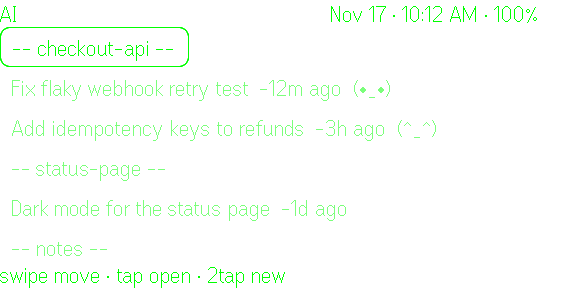

Picking up a coding session, dictating a request, and approving a tool call with one tap.
Picking up a coding session, dictating a request, and approving a tool call with one tap.
Claude Code sessions on the home machine, grouped by project.
frame 1 of 11
the ring
[the lens: frames captured from Even’s own simulator running the app on invented data · the views behind it: generated pictures, because the view through a lens cannot be photographed]
01why it exists
A screen you can read without leaving the room.
A phone takes you out of the conversation you are in. A laptop takes you out of the room. But the things that need a glance keep arriving: an agent waiting for permission, a sentence in a language you half understand, the next meeting.
The glasses put a few lines of text where you are already looking, and the ring answers them without a word. The whole product is the question of what a day looks like inside that constraint: one small monochrome display, one font, four gestures.
The hard parts were not the agents. They were the decisions about what to leave off the lens.
- 576 × 288
- green pixels per eye; black is see-through
- 4
- inputs: tap, double-tap, swipe up, swipe down
- 6
- cards in the carousel
- 2
- AI agents, both connected all the time
- 1
- built-in font, in one size
- 0
- images on the lens
02what is on the lens
Six cards, one tap apart.
Claude, from the ring
- Claude Code sessions on the home machine, grouped by project
- Tap to talk, tap to send; the draft appears on the lens as it is heard
- When Claude wants to run something it stops and asks: tap allows, double-tap denies
- Swipe to say no with a reason, by voice, and Claude tries a narrower way
- Ask about people and plans: Claude can search a personal knowledge graph
Honey, hands-free
- A voice companion that runs on models at home
- Free talk: speak, pause, and it sends itself
- She does things in the house: the lights, the television, a movie mode
- She remembers: recall from her own memory graph
- A small face in the footer shows her mood
Brain: captions and translation
- Transcribe: a meeting written down as it happens, scrolled back with a swipe
- Translate: someone speaks Thai, English lines appear; your own voice is left out
- Save a transcript and get its action items, pulled out by a model at home
- A library of saved transcripts and notes, with a paged reader
- Fact mode checks the last half-minute of what was said
Mail and calendar
- Unread mail as a list; a message opens into pages
- The day as half-hour slots from now, with to-dos at the top
- Tap a to-do to tick it off
- More than one Google account; the sign-in stays on the home machine
Work
- One ranked feed of what needs attention
- People who matter are always shown
- To-dos are filed from the feed by themselves
- A recorder for in-person meetings; the audio never leaves home
Everywhere
- An always-on frame: the card’s name, the clock, the battery, what the ring does now
- Say “go to mail” from any card
- Alerts take the top-left corner and then get out of the way
- Min mode keeps three lines at the bottom of your view
- It sleeps on its own and wakes only on purpose
03decisions · the display
Designing for 576 by 288, in one font.
Most of these were learned on the device, by getting them wrong first.
- the displayMeasure the screen; do not trust the numbers.
- The lens has one built-in font, not monospaced, in one size. Lines were measured on the device at 27 pixels, which won back an eighth line of text. A non-breaking space measures 6.85 pixels, not the 5 the library reports; that error clipped the clock. The layout now rounds so that it always under-fills, never overflows.
- the displayOnly draw what the font can draw.
- Glyphs the font lacks are silently skipped: spinners, ticks, checkboxes and colour codes all render as nothing. So status is shown with the shapes that exist: corner triangles, mic-level bars, open and filled circles, and a table-flip face when something breaks.
- the displayEnglish on the lens, whatever is spoken.
- There are no Thai, Chinese, Japanese or Devanagari glyphs. A Thai sentence would be a blank line. So translation always lands in English, and even plain transcription translates speech that is not English, because a blank line is worse than a translated one.
- the displayThe frame never moves.
- The card’s name, the clock and the footer live in their own containers. A clock tick or an arriving alert can never shift a live transcript by a line while you are reading it.
- the displayNo pictures and no borders.
- Black is transparent on this display, but a blank image draws as an opaque black box in the middle of your view, and changing the number of images during a redraw crashes the firmware. Borders were tried and read as clutter over the real world. The app is text only.
- listsAnything that changes on a timer stays out of lists.
- Scrolling text rubber-bands; the device’s native lists scroll properly but cannot be updated in place. So row labels stay fixed and the value that changes goes in the footer. Lists hold twenty rows of sixty-four characters, which is why the calendar starts at the current half-hour instead of at midnight.
- readingScroll by the page, keep one line.
- The glasses cannot scroll smoothly, so a swipe turns a whole screen and carries the last line over as a place-marker. Swiping up also stops the view from jumping to new text while you are reading old text.
04decisions · the ring
Four gestures, and a wearer who is doing something else.
- the ringEverything works from the ring, silently.
- The touchpad on the temple is unreliable under long hair, and there are places you cannot speak. The test for every feature was a cinema: could it be done without a sound and without touching my face?
- the ringThe footer always says what the ring does now.
- Four gestures have to mean different things on different screens. Rather than ask the wearer to remember, the bottom line of the lens spells it out: “tap yes · 2tap no · swipe = add thoughts”.
- wakingWaking is deliberate.
- A ring gets knocked all day. Asleep, a single tap only peeks for a second and a half. Waking takes two double-taps within two seconds, and speech never wakes the display. A triple-tap was tried and dropped. The phone keeps a “wake now” button in case the gesture ever fails.
- attentionMin mode instead of off.
- In a conversation a full screen of text is rude. Min mode keeps the app running and shows only three lines, anchored to the bottom of the view so eye contact survives. Text in the middle of the view was tried first; it “floated” over people’s faces.
- no trapsDouble-tap, repeated, always gets you out.
- Two apps once trapped the wearer in a loop between settings and chat, with no way back but the phone. The rule since: repeated double-taps always return to the carousel, and an automated test walks every card to prove it.
05decisions · what goes on it
One app, six cards.
- the rosterOne app that hosts all the others.
- The glasses run one plugin at a time. If Claude were one plugin and captions another, an approval could never reach you during a meeting. So EvenHub is the one plugin, every card lives inside it, and every backend stays connected in the background.
- the rosterFewer cards.
- Honey and Claude became one AI card: the screen is too small to be in both at once. Transcribe, Translate and Notes became Brain. The home screen was removed, because the carousel is already the picker. Six cards, each one tap apart.
- the rosterOne switch separates captions from translation.
- “Include my speech.” On, it is a meeting record with everyone in it. Off, it is a subtitle track for the other person, and you never see your own words echoed back at you.
06decisions · trust, privacy, speed
An agent on your face needs rules.
- trustThe agent stops and asks; one tap answers.
- Claude Code can run commands on a real machine. Each one that needs permission appears on the lens as “ALLOW?” with the exact command. Tap allows it, double-tap refuses, and a swipe refuses with a spoken reason so the agent can try something narrower. Claude is also told that its instructions arrive by voice, and to check before acting on a garbled word when the action cannot be undone.
- trustTwo lanes: what can run code never touches the public internet.
- The coding agent, the knowledge graph, system controls and saved transcripts are reachable only over a private network. Only chat and captions, behind tokens, are reachable from outside. The app checks this split when it starts, and it was tested by breaking it on purpose.
- privacyWhat is said in a room stays at home.
- Meeting audio is transcribed on a machine at home and never sent to a cloud service; action items are extracted by a local model. The location permission was removed from the app entirely, along with the weather feature that needed it.
- privacyThe knowledge graph is curated, read-only and never the raw archive.
- Claude can search two small graphs, of people and of remembered facts. It cannot write to them, and it cannot reach the full archive of messages and photographs they were distilled from.
- speedDraw less often than you could.
- The Bluetooth link to the glasses queues up if it is fed too fast, so redraws wait 120 milliseconds and animations pause while text is streaming. Captions commit a word only once two passes agree on it, then a slower, more careful pass corrects each finished sentence.
- batteryThe microphone is the cost, not the display.
- The lens sips power; an open mic does not. After about five minutes of silence the mic is dropped, unless a session is running.
07how it is built, and what is next
Thin on the glasses, heavy at home.
The app on the glasses is a small TypeScript program inside the phone’s companion app. It draws text and listens to the ring. Everything heavy runs on machines at home: the bridge that runs Claude’s agent and asks permission, speech recognition on a graphics card, Honey’s own language model, and the connections to mail and calendar.
That split is why it is fast, and why the private things stay private.
not done yet
- An approval’s alert should take you to Claude with one tap; today you go by voice (“go to AI”).
- Min mode shows the three lines it had when it shrank; it should keep following the conversation.
- Recall from the knowledge graph inside Brain, so a meeting can answer “what did we decide last time?”.